
Ch. 07 - Work and Energy
Giancoli Douglas - Physics for Scientists and Engineers 5th edition
Giancoli Douglas5th editionPhysics for Scientists and EngineersISBN: 9780137488179Not the one you use?Change textbook
Chapter 7, Problem 3

A 55.0-kg firefighter climbs a flight of stairs 28.0 m high at constant speed. How much work does she do?

Verified step by step guidance
1
Identify the formula for work done against gravity: \( W = m \cdot g \cdot h \), where \( m \) is the mass of the firefighter, \( g \) is the acceleration due to gravity (approximately \( 9.8 \, \text{m/s}^2 \)), and \( h \) is the height climbed.
Substitute the given values into the formula: \( m = 55.0 \, \text{kg} \), \( g = 9.8 \, \text{m/s}^2 \), and \( h = 28.0 \, \text{m} \).
Perform the multiplication: First, calculate \( m \cdot g \), then multiply the result by \( h \).
Ensure the units are consistent: The mass is in kilograms, the height is in meters, and the acceleration due to gravity is in meters per second squared, so the resulting work will be in joules (\( \text{J} \)).
Interpret the result: The work done represents the energy expended by the firefighter to climb the stairs at constant speed, overcoming the force of gravity.

Verified video answer for a similar problem:

This video solution was recommended by our tutors as helpful for the problem above.
Video duration:
2m
Was this helpful?

Key Concepts

Here are the essential concepts you must grasp in order to answer the question correctly.

Work

In physics, work is defined as the product of the force applied to an object and the distance over which that force is applied, in the direction of the force. Mathematically, it is expressed as W = F × d × cos(θ), where W is work, F is the force, d is the distance, and θ is the angle between the force and the direction of motion. When an object moves vertically against gravity, the work done is related to the gravitational force acting on the object.
Recommended video:
Guided course
06:58
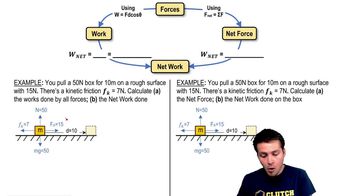
Calculating Net Work

Gravitational Force

Gravitational force is the attractive force that exists between any two masses. On Earth, this force can be calculated using the equation F = m × g, where F is the gravitational force, m is the mass of the object, and g is the acceleration due to gravity (approximately 9.81 m/s²). For the firefighter, her weight (mass times gravity) is the force she must work against while climbing the stairs.
Recommended video:
Guided course
05:41
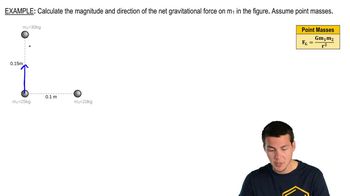
Gravitational Forces in 2D

Constant Speed

When an object moves at constant speed, it means that its velocity remains unchanged over time, implying that the net force acting on it is zero. In the context of the firefighter climbing stairs, moving at constant speed indicates that the work done against gravity is equal to the gravitational potential energy gained, and there is no acceleration involved. This simplifies the calculation of work, as the force exerted is equal to her weight.
Recommended video:
Guided course
08:59
Phase Constant of a Wave Function