
Textbook Question
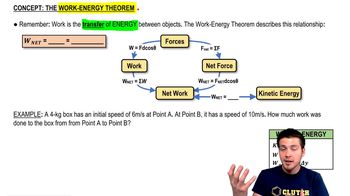
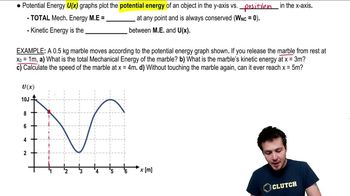
Estimate the work you do to mow a lawn 10 m by 20 m with a 50-cm-wide mower. Assume you push with a horizontal force of about 15 N.
1
views

 Verified step by step guidance
 04:10
04:10
 07:24
07:24 07:30
07:30Estimate the work you do to mow a lawn 10 m by 20 m with a 50-cm-wide mower. Assume you push with a horizontal force of about 15 N.
A 2.0-kg block slides across a rough surface with a constant coefficient of kinetic friction of 0.50 (Fig. 7–38a). The block starts at x= 0 with an initial velocity of 4.9 m/s. Pushing the block is a force directed at 36.8° below the horizontal and whose magnitude increases with position as shown in Fig. 7–38b.
<IMAGE>
(d) Draw a line on the graph showing the magnitude of the friction force versus distance x.
A 55.0-kg firefighter climbs a flight of stairs 28.0 m high at constant speed. How much work does she do?
In a certain library the first shelf is 15.0 cm off the ground, and the remaining four shelves are each spaced 38.0 cm above the previous one. If the average book has a mass of 1.25 kg with a height of 22.0 cm, and an average shelf holds 28 books (standing vertically), how much work is required to fill all the shelves, assuming the books are all laying flat on the floor to start?