
Textbook Question
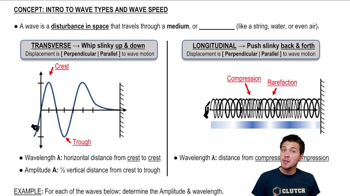
A transverse wave with a frequency of 220 Hz and a wavelength of 10.0 cm is traveling along a cord. The maximum speed of particles on the cord is 0.10 the wave speed. What is the amplitude of the wave?
1
views

 Verified step by step guidance
 07:19
07:19
 05:08
05:08 10:40
10:40A transverse wave with a frequency of 220 Hz and a wavelength of 10.0 cm is traveling along a cord. The maximum speed of particles on the cord is 0.10 the wave speed. What is the amplitude of the wave?
A 572-Hz longitudinal wave in air has a speed of 345 m/s. At a particular instant, what is the phase difference (in degrees) between two points 4.4 cm apart?
A 572-Hz longitudinal wave in air has a speed of 345 m/s. What is the wavelength?
Write the equation for the wave in Problem 29 traveling to the right, if its amplitude is 0.020 cm, and D = - 0.020 cm, at t = 0 and x = 0.
A transverse wave on a cord is given by D(x,t) = 0.12 sin (3.0x - 15.0t), where D and x are in meters and t is in seconds. At t = 0.20s, what are the displacement, velocity, and acceleration of a point on the cord where x = 0.60 m?
A transverse wave pulse travels to the right along a string with a speed v = 2.0 m/s. At the shape of the pulse is given by the function D = 0.45 cos (2.6x + 1.2), where D and x are in meters. Determine a formula for the wave pulse at any time t assuming there are no frictional losses.