Ch. 15 - Wave Motion
Giancoli Douglas - Physics for Scientists and Engineers 5th edition
Giancoli Douglas5th editionPhysics for Scientists and EngineersISBN: 9780137488179Not the one you use?Change textbook
Chapter 15, Problem 32b

A transverse wave on a cord is given by D(x,t) = 0.12 sin (3.0x - 15.0t), where D and x are in meters and t is in seconds. At t = 0.20s, what are the displacement, velocity, and acceleration of a point on the cord where x = 0.60 m?

Verified step by step guidance
1
Step 1: Write down the given wave equation: \( D(x, t) = 0.12 \sin(3.0x - 15.0t) \), where \( D \) is the displacement in meters, \( x \) is the position in meters, and \( t \) is the time in seconds. Identify the values given in the problem: \( t = 0.20 \, \text{s} \) and \( x = 0.60 \, \text{m} \).
Step 2: To find the displacement \( D \) at \( t = 0.20 \, \text{s} \) and \( x = 0.60 \, \text{m} \), substitute these values into the wave equation: \( D(0.60, 0.20) = 0.12 \sin(3.0(0.60) - 15.0(0.20)) \). Simplify the argument of the sine function to calculate \( D \).
Step 3: To find the velocity of the point on the cord, take the partial derivative of \( D(x, t) \) with respect to time \( t \): \( v(x, t) = \frac{\partial D(x, t)}{\partial t} = -0.12 \cdot 15.0 \cos(3.0x - 15.0t) \). Substitute \( x = 0.60 \, \text{m} \) and \( t = 0.20 \, \text{s} \) into this expression to calculate the velocity.
Step 4: To find the acceleration of the point on the cord, take the second partial derivative of \( D(x, t) \) with respect to time \( t \): \( a(x, t) = \frac{\partial^2 D(x, t)}{\partial t^2} = -0.12 \cdot 15.0^2 \sin(3.0x - 15.0t) \). Substitute \( x = 0.60 \, \text{m} \) and \( t = 0.20 \, \text{s} \) into this expression to calculate the acceleration.
Step 5: After substituting the values into the equations for displacement, velocity, and acceleration, simplify each expression to find the numerical results. Ensure the units are consistent throughout the calculations: displacement in meters, velocity in meters per second, and acceleration in meters per second squared.

Verified video answer for a similar problem:

This video solution was recommended by our tutors as helpful for the problem above.
Video duration:
7m
Was this helpful?

Key Concepts

Here are the essential concepts you must grasp in order to answer the question correctly.

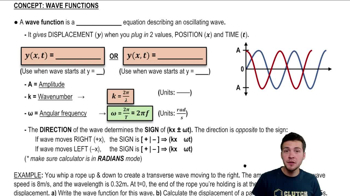
Wave Function

The wave function describes the displacement of a wave at any point in space and time. In this case, D(x, t) = 0.12 sin(3.0x - 15.0t) represents a sinusoidal wave, where the amplitude is 0.12 m, the wave number is 3.0 rad/m, and the angular frequency is 15.0 rad/s. Understanding the wave function is essential for determining the wave's behavior at specific points.
Recommended video:
Guided course
08:30
Intro to Wave Functions

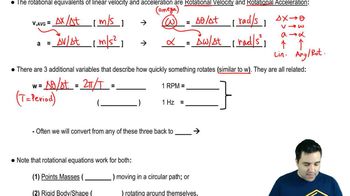
Displacement, Velocity, and Acceleration

Displacement refers to the position of a point on the wave at a given time, while velocity is the rate of change of displacement with respect to time, and acceleration is the rate of change of velocity. For a wave, these quantities can be derived from the wave function by taking the first and second derivatives with respect to time, allowing us to analyze the motion of points on the cord.
Recommended video:
Guided course
11:21
Rotational Velocity & Acceleration

Partial Derivatives

Partial derivatives are used to find how a function changes with respect to one variable while keeping others constant. In the context of wave motion, we use partial derivatives of the wave function D(x, t) to calculate the velocity and acceleration of a point on the cord at a specific position and time, which is crucial for solving the problem presented.
Recommended video:
Guided course
04:59
Partial Dielectrics