Ch 23: The Electric Field
Knight Calc - Physics for Scientists and Engineers 5th Edition
Knight Calc5th EditionPhysics for Scientists and EngineersISBN: 9780137344796Not the one you use?Change textbook
Chapter 23, Problem 5c

The electric field strength 1.5 cm from an electric dipole, on the axis of the dipole, is 1.5×10⁵ N/C. If the dipole is replaced by a single charge, what magnitude charge in nC will give the same field strength 1.5 cm away?

Verified step by step guidance
1
Step 1: Understand the problem. The electric field strength at a distance of 1.5 cm from a single charge is given as 1.5×10^5 N/C. We need to determine the magnitude of the charge (in nC) that produces this field strength.
Step 2: Recall the formula for the electric field due to a point charge: E=kq/r2, where E is the electric field strength, k is Coulomb's constant (8.99×10^9 N·m²/C²), q is the charge, and r is the distance from the charge.
Step 3: Rearrange the formula to solve for the charge q: q=E×r2/k. Substitute the given values: E=1.5×10⁵ N/C, r=0.015 m (converted from cm), and k=8.99×10⁹ N·m²/C².
Step 4: Perform the substitution into the formula: q=1.5×105×0.0152/8.99×109. Ensure all units are consistent (meters for distance, N/C for field strength).
Step 5: Convert the result for q into nanocoulombs (nC) by multiplying the value in coulombs by 10^9. This will give the magnitude of the charge in nC that produces the same field strength.

Verified video answer for a similar problem:

This video solution was recommended by our tutors as helpful for the problem above.
Video duration:
3m
Was this helpful?

Key Concepts

Here are the essential concepts you must grasp in order to answer the question correctly.

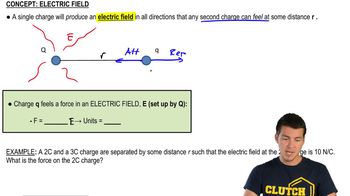
Electric Field

The electric field is a vector field that represents the force exerted by an electric charge on other charges in its vicinity. It is defined as the force per unit charge and is measured in newtons per coulomb (N/C). The strength of the electric field decreases with distance from the charge, following an inverse square law for point charges.
Recommended video:
Guided course
03:16
Intro to Electric Fields

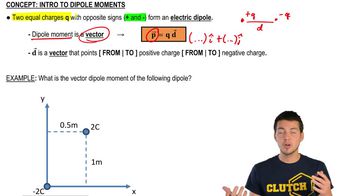
Electric Dipole

An electric dipole consists of two equal and opposite charges separated by a small distance. The electric field produced by a dipole varies with distance and direction, and on the axis of the dipole, it can be calculated using specific formulas. Understanding dipoles is crucial for analyzing how they influence the electric field in their surroundings.
Recommended video:
Guided course
03:08
Intro To Dipole Moment

Coulomb's Law

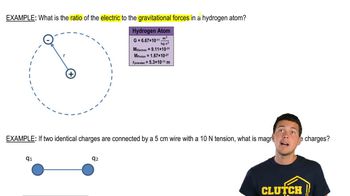
Coulomb's Law describes the force between two point charges and is fundamental in electrostatics. It states that the force is directly proportional to the product of the magnitudes of the charges and inversely proportional to the square of the distance between them. This law is essential for calculating the electric field generated by a single charge at a given distance.
Recommended video:
Guided course
09:52
Coulomb's Law