Ch 23: The Electric Field
Knight Calc - Physics for Scientists and Engineers 5th Edition
Knight Calc5th EditionPhysics for Scientists and EngineersISBN: 9780137344796Not the one you use?Change textbook
Chapter 23, Problem 6a

An electric dipole is formed from two charges, ±q, spaced 1.0 cm apart. The dipole is at the origin, oriented along the y-axis. The electric field strength at the point (x, y)=(0 cm, 10 cm) is 360 N/C. What is the charge q? Give your answer in nC.

Verified step by step guidance
1
Understand the problem: An electric dipole consists of two charges, +q and -q, separated by a distance of 1.0 cm. The dipole is aligned along the y-axis, and we are tasked with finding the magnitude of the charge q, given the electric field strength at a specific point (0 cm, 10 cm) is 360 N/C.
Recall the formula for the electric field along the axial line of a dipole: E = (1/(4πϵ₀)) * (2q * d) / r³, where q is the charge, d is the separation between the charges, r is the distance from the dipole center to the point of interest, and ϵ₀ is the permittivity of free space (8.85 × 10⁻¹² \, \(\text{C²/(N·m²)}\)).
Substitute the known values into the formula: The separation d = 1.0 \, \(\text{cm}\) = 0.01 \, \(\text{m}\), the distance r = 10 \, \(\text{cm}\) = 0.10 \, \(\text{m}\), and the electric field strength E = 360 \, \(\text{N/C}\). The formula becomes: 360 = (1/(4π × 8.85 × 10⁻¹²)) * (2q * 0.01) / (0.10)³.
Rearrange the equation to solve for q: First, calculate the denominator (0.10)³ = 0.001. Then, isolate q by multiplying both sides by 4π × 8.85 × 10⁻¹² × 0.001 and dividing by 2 × 0.01.
Simplify the expression to find q: Perform the arithmetic operations step by step to calculate the value of q in Coulombs, then convert it to nanocoulombs (nC) by multiplying by 10⁹.

Verified video answer for a similar problem:

This video solution was recommended by our tutors as helpful for the problem above.
Was this helpful?

Key Concepts

Here are the essential concepts you must grasp in order to answer the question correctly.

Electric Dipole

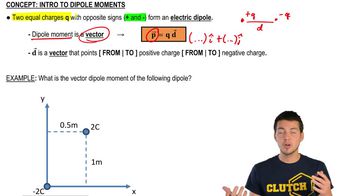
An electric dipole consists of two equal and opposite charges, +q and -q, separated by a distance. The dipole moment, a vector quantity, is defined as the product of the charge and the distance between the charges, indicating the dipole's strength and orientation. In this case, the dipole is oriented along the y-axis, which affects the electric field it generates.
Recommended video:
Guided course
03:08
Intro To Dipole Moment

Electric Field Strength

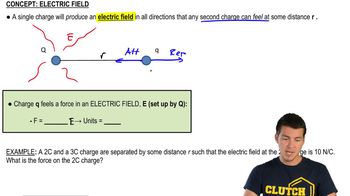
Electric field strength (E) is a measure of the force experienced by a unit positive charge placed in the field. It is a vector quantity, defined as the force per unit charge, and is influenced by the configuration of charges in the vicinity. The electric field due to a dipole decreases with distance and is calculated using specific formulas that account for the dipole's orientation and position.
Recommended video:
Guided course
03:16
Intro to Electric Fields

Coulomb's Law

Coulomb's Law describes the force between two point charges, stating that the force is directly proportional to the product of the magnitudes of the charges and inversely proportional to the square of the distance between them. This law is fundamental in calculating the electric field generated by charges, including dipoles, and is essential for determining the charge q in the given problem.
Recommended video:
Guided course
09:52
Coulomb's Law
Related Practice
Textbook Question

The electric field strength 1.5 cm from an electric dipole, on the axis of the dipole, is 1.5×10⁵ N/C. If the dipole is replaced by a single charge, what magnitude charge in nC will give the same field strength 1.5 cm away?

1
views

Textbook Question

What are the strength and direction of the electric field at the position indicated by the dot in FIGURE EX23.3? Specify the direction as an angle cw from horizontal.

Textbook Question

The electric field strength 1.5 cm from an electric dipole, on the axis of the dipole, is 1.5×10⁵ N/C. What is the dipole moment in nC mm?

Textbook Question

A 10-cm-long thin glass rod uniformly charged to +10 nC and a 10-cm-long thin plastic rod uniformly charged to −10 nC are placed side by side, 4.0 cm apart. What are the electric field strengths E1 to E3 at distances 1.0 cm, 2.0 cm, and 3.0 cm from the glass rod along the line connecting the midpoints of the two rods?

Textbook Question

A small glass bead charged to +6.0 nC is in the plane that bisects a thin, uniformly charged, 10-cm-long glass rod and is 4.0 cm from the rod's center. The bead is repelled from the rod with a force of 840 μN. What is the total charge on the rod?

1
views
Textbook Question

An electret is similar to a magnet, but rather than being permanently magnetized, it has a permanent electric dipole moment. Suppose a small electret with electric dipole moment 1.0×10⁻⁷ C m is 25 cm from a small ball charged to +25 nC, with the ball on the axis of the electric dipole. What is the magnitude of the electric force on the ball?