Ch 23: The Electric Field
Knight Calc - Physics for Scientists and Engineers 5th Edition
Knight Calc5th EditionPhysics for Scientists and EngineersISBN: 9780137344796Not the one you use?Change textbook
Chapter 23, Problem 8

A 10-cm-long thin glass rod uniformly charged to +10 nC and a 10-cm-long thin plastic rod uniformly charged to −10 nC are placed side by side, 4.0 cm apart. What are the electric field strengths E1 to E3 at distances 1.0 cm, 2.0 cm, and 3.0 cm from the glass rod along the line connecting the midpoints of the two rods?

Verified step by step guidance
1
Understand the problem: We are tasked with calculating the electric field strengths at three specific points along the line connecting the midpoints of two uniformly charged rods. The rods are oppositely charged, and the electric field at each point will be the vector sum of the contributions from both rods.
Step 1: Use the formula for the electric field due to a uniformly charged rod at a point along its perpendicular bisector. The electric field magnitude at a distance \( r \) from the midpoint of a uniformly charged rod of length \( L \) and linear charge density \( \lambda \) is given by: \( E = \frac{1}{4 \pi \epsilon_0} \cdot \frac{2 \lambda}{r \sqrt{r^2 + (L/2)^2}} \). Here, \( \lambda = \frac{Q}{L} \), where \( Q \) is the total charge on the rod.
Step 2: Calculate the linear charge density \( \lambda \) for both rods. For the glass rod, \( \lambda_{glass} = \frac{+10 \times 10^{-9} \text{ C}}{0.1 \text{ m}} \). For the plastic rod, \( \lambda_{plastic} = \frac{-10 \times 10^{-9} \text{ C}}{0.1 \text{ m}} \). These values will be used in the electric field formula.
Step 3: Determine the electric field contributions from each rod at the specified distances (1.0 cm, 2.0 cm, and 3.0 cm) from the glass rod. For each distance, calculate the electric field due to the glass rod using the formula in Step 1. Then calculate the electric field due to the plastic rod, which is located 4.0 cm away from the glass rod. The distance from the plastic rod to the point of interest will be \( r_{plastic} = 4.0 \text{ cm} - r_{glass} \).
Step 4: Add the electric field contributions from both rods as vectors. Since the rods are oppositely charged, their electric fields will point in opposite directions along the line connecting their midpoints. Use vector addition to find the net electric field at each point. The net electric field is \( E_{net} = E_{glass} - E_{plastic} \), where the direction of each field is taken into account.

Verified video answer for a similar problem:

This video solution was recommended by our tutors as helpful for the problem above.
Was this helpful?

Key Concepts

Here are the essential concepts you must grasp in order to answer the question correctly.

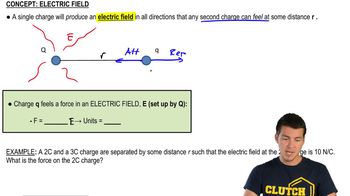
Electric Field

The electric field is a vector field that represents the force exerted by an electric charge on other charges in its vicinity. It is defined as the force per unit charge and is measured in newtons per coulomb (N/C). The direction of the electric field is away from positive charges and towards negative charges, influencing how other charges will move in the field.
Recommended video:
Guided course
03:16
Intro to Electric Fields

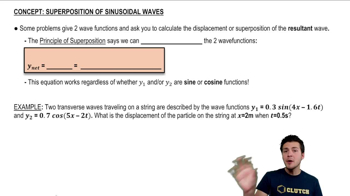
Superposition Principle

The superposition principle states that the total electric field created by multiple charges is the vector sum of the electric fields produced by each charge individually. This principle allows us to analyze complex charge configurations by calculating the electric field contributions from each charge separately and then combining them to find the resultant field at a given point.
Recommended video:
Guided course
03:32
Superposition of Sinusoidal Wave Functions

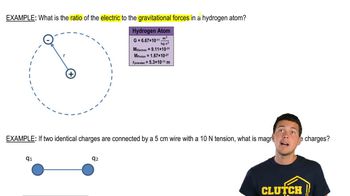
Coulomb's Law

Coulomb's Law describes the force between two point charges and is fundamental in calculating electric fields. It states that the electric force between two charges is directly proportional to the product of the magnitudes of the charges and inversely proportional to the square of the distance between them. This law is essential for determining the electric field strength generated by charged objects.
Recommended video:
Guided course
09:52
Coulomb's Law
Related Practice
Textbook Question

The electric field strength 1.5 cm from an electric dipole, on the axis of the dipole, is 1.5×10⁵ N/C. If the dipole is replaced by a single charge, what magnitude charge in nC will give the same field strength 1.5 cm away?

1
views

Textbook Question

CALC A 12-cm-long thin rod has the nonuniform charge density λ(x)=(2.0nC/cm)ex/(6.0cm)\(\lambda\)(x)=(2.0\,\(\text{nC/cm}\))e^{-|x|/(6.0\,\(\text{cm}\))}, where x is measured from the center of the rod. What is the total charge on the rod? Hint: This exercise requires an integration. Think about how to handle the absolute value sign.

1
views
Textbook Question

A small glass bead charged to +6.0 nC is in the plane that bisects a thin, uniformly charged, 10-cm-long glass rod and is 4.0 cm from the rod's center. The bead is repelled from the rod with a force of 840 μN. What is the total charge on the rod?

1
views
Textbook Question

An electric dipole is formed from two charges, ±q, spaced 1.0 cm apart. The dipole is at the origin, oriented along the y-axis. The electric field strength at the point (x, y)=(0 cm, 10 cm) is 360 N/C. What is the charge q? Give your answer in nC.

1
views
Textbook Question

An electret is similar to a magnet, but rather than being permanently magnetized, it has a permanent electric dipole moment. Suppose a small electret with electric dipole moment 1.0×10⁻⁷ C m is 25 cm from a small ball charged to +25 nC, with the ball on the axis of the electric dipole. What is the magnitude of the electric force on the ball?

Textbook Question

Two 10-cm-long thin glass rods uniformly charged to +10 nC are placed side by side, 4.0 cm apart. What are the electric field strengths E1 to E3 at distances 1.0 cm, 2.0 cm, and 3.0 cm to the right of the rod on the left along the line connecting the midpoints of the two rods?