
Ch 20: The Micro/Macro Connection
Knight Calc - Physics for Scientists and Engineers 5th Edition
Knight Calc5th EditionPhysics for Scientists and EngineersISBN: 9780137344796Not the one you use?Change textbook
Chapter 20, Problem 38b

Your calculator can't handle enormous exponents, but we can make sense of large powers of e by converting them to large powers of 10. If we write e = 10α, then eβ = (10α)β = 10αβ. What is the multiplicity of a macrostate with entropy S = 1.0 J/K? Give your answer as a power of 10.

Verified step by step guidance
1
The multiplicity (Ω) of a macrostate is related to its entropy (S) by the formula: S = k_B * ln(Ω), where k_B is the Boltzmann constant (k_B ≈ 1.38 × 10^-23 J/K). Rearrange this equation to solve for Ω: Ω = e^(S / k_B).
To simplify the calculation, note that e can be expressed as a power of 10: e = 10^α, where α ≈ 0.434. This allows us to rewrite e^(S / k_B) as 10^(α * (S / k_B)).
Substitute the given entropy S = 1.0 J/K and the value of k_B into the expression: S / k_B = 1.0 / (1.38 × 10^-23). This gives the exponent for the power of e.
Now, multiply the result of S / k_B by α (0.434) to convert the base e exponent into a base 10 exponent. This gives the final exponent for the power of 10.
Express the multiplicity Ω as 10^(α * (S / k_B)), where the exponent is the value calculated in the previous step. This is the multiplicity of the macrostate as a power of 10.

Verified video answer for a similar problem:

This video solution was recommended by our tutors as helpful for the problem above.
Video duration:
5m
Was this helpful?

Key Concepts

Here are the essential concepts you must grasp in order to answer the question correctly.

Entropy

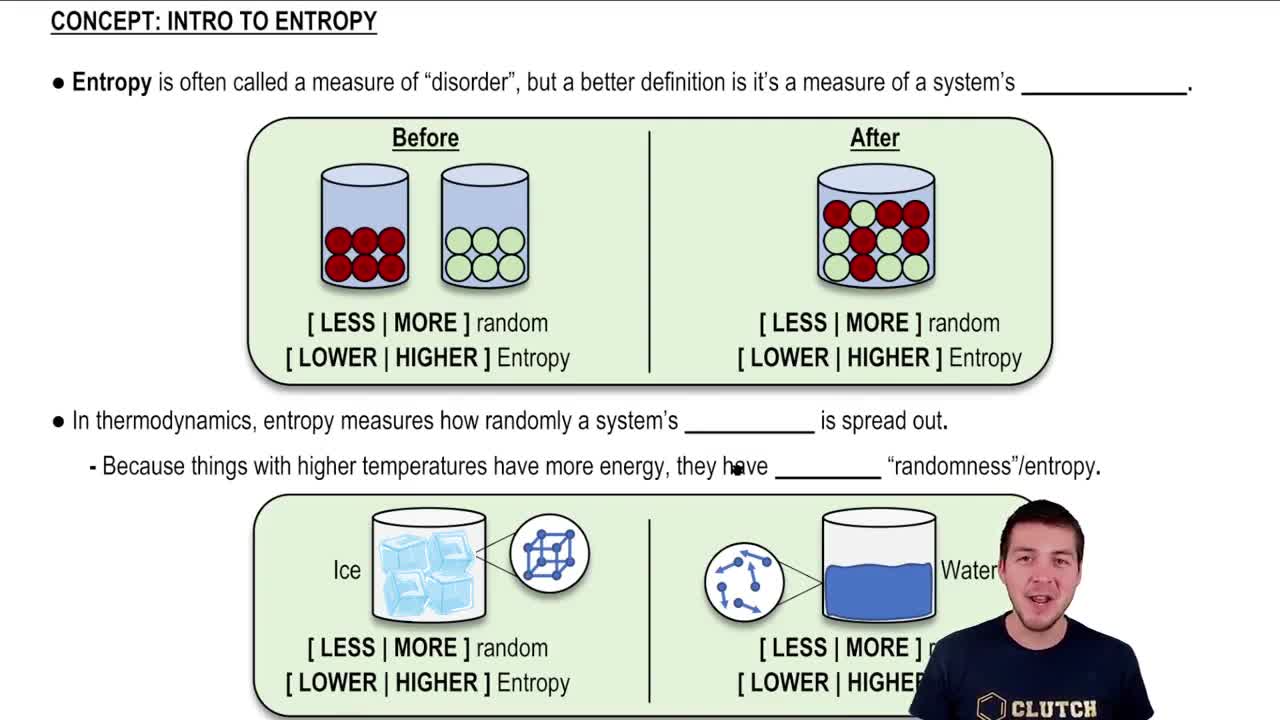
Entropy is a measure of the disorder or randomness in a system, often associated with the number of microscopic configurations that correspond to a macroscopic state. In thermodynamics, higher entropy indicates a greater number of possible arrangements of particles, leading to increased disorder. The relationship between entropy and multiplicity is fundamental, as entropy can be calculated using the formula S = k * ln(Ω), where k is the Boltzmann constant and Ω is the multiplicity.
Recommended video:
Guided course
07:50
Intro to Entropy

Multiplicity

Multiplicity refers to the number of distinct microscopic states that correspond to a particular macroscopic state of a system. It quantifies how many ways a system can be arranged while still exhibiting the same overall properties. In statistical mechanics, multiplicity is crucial for understanding the relationship between entropy and the likelihood of a system being in a certain state, as higher multiplicity corresponds to higher entropy.
Recommended video:
Guided course
14:31
Equilibrium with Multiple Supports

Exponential Growth and Logarithms

Exponential growth describes a process where a quantity increases at a rate proportional to its current value, often represented mathematically as e^x or 10^x. Logarithms are the inverse operations of exponentiation, allowing us to express large numbers in a more manageable form. In the context of the question, converting between bases (e and 10) using logarithmic relationships helps simplify calculations involving large powers, making it easier to express multiplicity in terms of powers of 10.
Recommended video:
Related Practice