
Ch 20: The Micro/Macro Connection
Knight Calc - Physics for Scientists and Engineers 5th Edition
Knight Calc5th EditionPhysics for Scientists and EngineersISBN: 9780137344796Not the one you use?Change textbook
Chapter 20, Problem 30

The vibrational modes of molecular nitrogen are 'frozen out' at room temperature but become active at temperatures above ≈1500 K. The temperature in the combustion chamber of a jet engine can reach 2000 K, so an engineering analysis of combustion requires knowing the thermal properties of materials at these temperatures. What is the expected specific heat ratio γ for nitrogen at 2000 K?

Verified step by step guidance
1
Understand the concept of specific heat ratio γ: It is defined as the ratio of the specific heat at constant pressure (Cp) to the specific heat at constant volume (Cv), expressed as γ = Cp/Cv. For diatomic gases like nitrogen, γ depends on the degrees of freedom available for energy storage.
Determine the degrees of freedom for nitrogen at 2000 K: At room temperature, only translational and rotational modes contribute to the energy storage, giving 5 degrees of freedom. At 2000 K, vibrational modes become active, adding 2 more degrees of freedom, resulting in a total of 7 degrees of freedom.
Calculate Cv using the degrees of freedom: The specific heat at constant volume for a diatomic gas is given by Cv = (f/2)R, where f is the number of degrees of freedom and R is the universal gas constant. Substitute f = 7 into the formula to find Cv.
Calculate Cp using the relationship Cp = Cv + R: Once Cv is determined, add the universal gas constant R to Cv to find Cp.
Determine γ using the formula γ = Cp/Cv: Divide Cp by Cv to find the specific heat ratio γ for nitrogen at 2000 K.

Verified video answer for a similar problem:

This video solution was recommended by our tutors as helpful for the problem above.
Video duration:
4m
Was this helpful?

Key Concepts

Here are the essential concepts you must grasp in order to answer the question correctly.

Specific Heat Ratio (γ)

The specific heat ratio, denoted as γ (gamma), is the ratio of the specific heat capacity at constant pressure (Cp) to that at constant volume (Cv). It is a crucial parameter in thermodynamics, particularly in understanding the behavior of gases during processes such as combustion. For diatomic gases like nitrogen, γ typically approaches 1.4 at room temperature but can change with temperature due to the activation of vibrational modes.
Recommended video:
Guided course
06:50
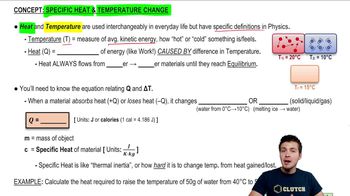
Specific Heat & Temperature Changes

Vibrational Modes

Vibrational modes refer to the different ways in which the atoms in a molecule can vibrate. For diatomic molecules like nitrogen (N2), these modes become 'frozen out' at lower temperatures, meaning they do not contribute to the energy of the system. As temperature increases, these vibrational modes become active, contributing to the internal energy and affecting thermodynamic properties such as specific heat.
Recommended video:
Guided course
07:58
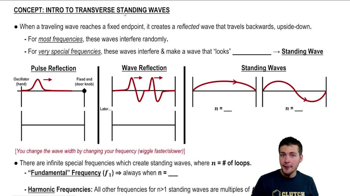
Intro to Transverse Standing Waves

Thermal Properties of Materials

Thermal properties of materials include characteristics such as specific heat, thermal conductivity, and thermal expansion, which dictate how materials respond to changes in temperature. In high-temperature environments like a jet engine combustion chamber, understanding these properties is essential for predicting material behavior, ensuring structural integrity, and optimizing performance. The specific heat capacity, in particular, influences how much energy is required to raise the temperature of a substance.
Recommended video:
Guided course
05:21
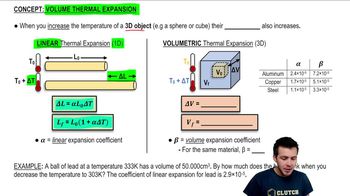
Volume Thermal Expansion