Ch.6 - Alkyl Halides; Nucleophilic Substitution
Wade - Organic Chemistry 9th Edition
Wade9th EditionOrganic ChemistryISBN: 9780135213728Not the one you use?Change textbook
Chapter 6, Problem 10d

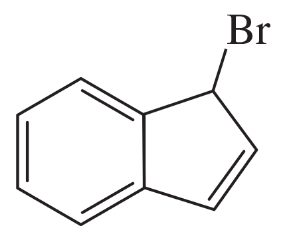
Show how free-radical halogenation might be used to synthesize the following ­compounds. In each case, explain why we expect to get a single major product.
(d)

Verified step by step guidance
1
Step 1: Identify the target compound and analyze its structure. The compound shown is a brominated bicyclic structure with a bromine atom attached to the benzylic position of the bicyclic ring system. This position is particularly reactive due to the stability of the benzylic radical formed during the reaction.
Step 2: Understand the mechanism of free-radical halogenation. Free-radical halogenation involves three steps: initiation, propagation, and termination. In the initiation step, a halogen molecule (e.g., Br2) is split into two bromine radicals by heat or light. These radicals are highly reactive and initiate the reaction.
Step 3: Determine the most reactive site for halogenation. In this case, the benzylic position is the most reactive due to the resonance stabilization of the benzylic radical. When a hydrogen atom is abstracted from this position, the resulting radical is stabilized by delocalization of electrons into the aromatic ring.
Step 4: Predict the major product. Since the benzylic radical is highly stabilized, bromination will predominantly occur at this position, leading to the formation of the single major product shown in the image. Other positions on the bicyclic ring system are less reactive and unlikely to undergo halogenation.
Step 5: Explain why a single major product is expected. The regioselectivity of the reaction is driven by the stability of the intermediate radical. The benzylic radical is significantly more stable than radicals formed at other positions, ensuring that bromination occurs exclusively at this site under typical free-radical halogenation conditions.

Verified video answer for a similar problem:

This video solution was recommended by our tutors as helpful for the problem above.
Video duration:
7m
Was this helpful?

Key Concepts

Here are the essential concepts you must grasp in order to answer the question correctly.

Free-Radical Halogenation

Free-radical halogenation is a reaction where alkanes react with halogens (like bromine) in the presence of heat or light to form alkyl halides. This process involves the generation of free radicals, which are highly reactive species with unpaired electrons. The reaction proceeds through three main steps: initiation, propagation, and termination, leading to the substitution of hydrogen atoms with halogen atoms.
Recommended video:
Guided course
12:11
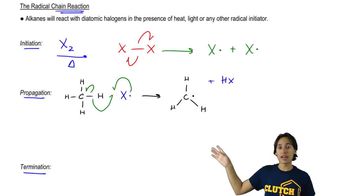
Radical Chain Reaction Mechanism.

Selectivity in Free-Radical Reactions

Selectivity in free-radical halogenation refers to the preference for the formation of certain products over others. This is influenced by the stability of the free radicals formed during the reaction. More stable radicals (like tertiary radicals) are favored, leading to a single major product when the substrate has a clear preference for one site of substitution, as seen in the provided compound.
Recommended video:
Guided course
10:08
Radical selectivity:Alcoholics Anonymous Version

Mechanism of Bromination

The mechanism of bromination involves the formation of a bromine radical that abstracts a hydrogen atom from the substrate, creating a new radical. This radical can then react with another bromine molecule to form the brominated product. The specific structure of the compound in the image suggests that bromination will occur at a position that leads to a stable radical, thus resulting in a single major product due to the lack of competing sites for substitution.
Recommended video:
Guided course
00:54
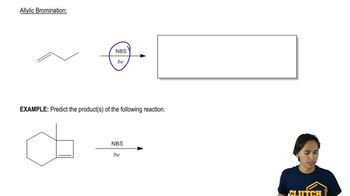
Mechanism of Allylic Bromination.