
Textbook Question
Under certain conditions, the reaction of 0.5 M 1-bromobutane with 1.0 M sodium methoxide forms 1-methoxybutane at a rate of 0.05 mol/L per second. What would be the rate if 0.1 M 1-bromobutane and 2.0 M NaOCH3 were used?
8
views

 Verified step by step guidance
 01:34
01:34
 00:40
00:40 07:22
07:22Under certain conditions, the reaction of 0.5 M 1-bromobutane with 1.0 M sodium methoxide forms 1-methoxybutane at a rate of 0.05 mol/L per second. What would be the rate if 0.1 M 1-bromobutane and 2.0 M NaOCH3 were used?
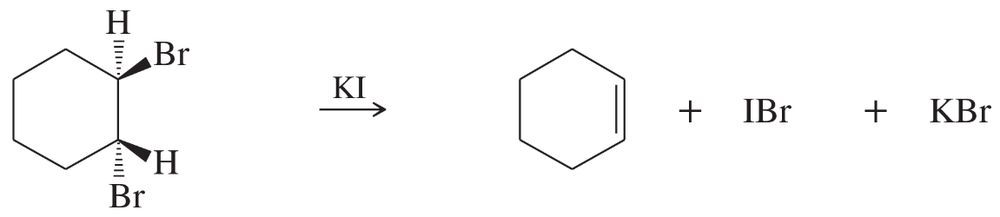
Classify each reaction as a substitution, an elimination, or neither. Identify the leaving group in each reaction, and the nucleophile in substitutions.
b.
Show how free-radical halogenation might be used to synthesize the following compounds. In each case, explain why we expect to get a single major product.
(d)
Classify each reaction as a substitution, an elimination, or neither. Identify the leaving group in each reaction, and the nucleophile in substitutions.
a.
Under certain conditions, the reaction of 0.5 M 1-bromobutane with 1.0 M sodium methoxide forms 1-methoxybutane at a rate of 0.05 mol/L per second.
c. Show another SN2 reaction using a different combination of an alkoxide and an alkyl bromide that also produces 1-methoxybutane.
Consider the reaction of 1-bromobutane with a large excess of ammonia (NH3). Draw the reactants, the transition state, and the products. Note that the initial product is the salt of an amine (RNH3+Br−), which is deprotonated by the excess ammonia to give the amine.