
For each pair of compounds, predict which compound has the higher boiling point. Check [TABLE 6-2] to see if your prediction was right; then explain why that compound has the higher boiling point.
c. 1-bromobutane and 1-chlorobutane
Verified step by step guidance
For each pair of compounds, predict which compound has the higher boiling point. Check [TABLE 6-2] to see if your prediction was right; then explain why that compound has the higher boiling point.
c. 1-bromobutane and 1-chlorobutane
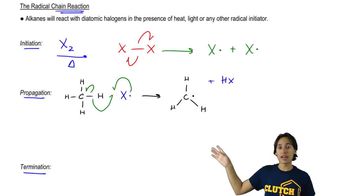
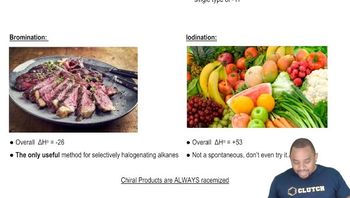
Show how free-radical halogenation might be used to synthesize the following compounds. In each case, explain why we expect to get a single major product.
(d)
Show how free-radical halogenation might be used to synthesize the following compounds. In each case, explain why we expect to get a single major product.
(c)
The light-initiated reaction of 2,3-dimethylbut-2-ene with N-bromosuccinimide (NBS) gives two products:
a. Give a mechanism for this reaction, showing how the two products arise as a consequence of the resonance-stabilized intermediate.
Classify each reaction as a substitution, an elimination, or neither. Identify the leaving group in each reaction, and the nucleophile in substitutions.
a.
The light-initiated reaction of 2,3-dimethylbut-2-ene with N-bromosuccinimide (NBS) gives two products:
b. The bromination of cyclohexene using NBS gives only one major product, as shown on the previous page. Explain why there is no second product from an allylic shift.