Ch.6 - Alkyl Halides; Nucleophilic Substitution
Wade - Organic Chemistry 9th Edition
Wade9th EditionOrganic ChemistryISBN: 9780135213728Not the one you use?Change textbook
Chapter 6, Problem 40c,d

Give the substitution products expected from solvolysis of each compound by heating in ethanol.
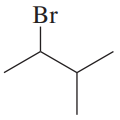
(c) Bromine atom attached to a carbon chain, illustrating a compound for solvolysis in ethanol.
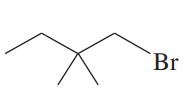
(d) Chemical structure showing a bromine atom attached to a branched alkane, illustrating substitution products from solvolysis in ethanol.

Verified step by step guidance
1
Step 1: Identify the type of halide in each compound. Both compounds contain a bromine atom attached to a carbon atom. In compound (c), bromine is attached to a secondary carbon, while in compound (d), bromine is attached to a tertiary carbon.
Step 2: Recognize the reaction conditions. Solvolysis in ethanol typically proceeds via an SN1 mechanism, especially for secondary and tertiary alkyl halides. This involves the formation of a carbocation intermediate after the departure of the bromide ion.
Step 3: Analyze the stability of the carbocation intermediates. In compound (c), the secondary carbocation formed is moderately stable. In compound (d), the tertiary carbocation formed is highly stable due to hyperconjugation and inductive effects from the surrounding alkyl groups.
Step 4: Predict the substitution product. Ethanol acts as the nucleophile in this reaction. After the carbocation is formed, ethanol will attack the positively charged carbon, leading to the formation of an ethyl ether product (R-OCH2CH3).
Step 5: Consider any potential rearrangements. For compound (c), no rearrangement is expected as the secondary carbocation is relatively stable. For compound (d), no rearrangement is needed as the tertiary carbocation is already highly stable.

Verified video answer for a similar problem:

This video solution was recommended by our tutors as helpful for the problem above.
Video duration:
15m
Was this helpful?

Key Concepts

Here are the essential concepts you must grasp in order to answer the question correctly.

Solvolysis

Solvolysis is a type of nucleophilic substitution reaction where a solvent acts as a nucleophile. In organic chemistry, this often involves the reaction of an alkyl halide with a solvent like ethanol, leading to the formation of substitution products. The reaction typically proceeds through either an SN1 or SN2 mechanism, depending on the structure of the substrate and the conditions of the reaction.
Recommended video:
Guided course
08:16
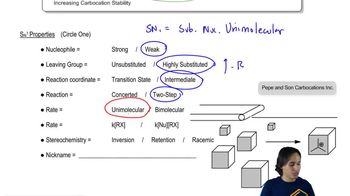
Understanding the properties of SN1.

Nucleophilic Substitution Mechanisms

Nucleophilic substitution can occur via two primary mechanisms: SN1 and SN2. The SN1 mechanism involves a two-step process where the leaving group departs first, forming a carbocation intermediate, followed by nucleophilic attack. In contrast, the SN2 mechanism is a one-step process where the nucleophile attacks the substrate simultaneously as the leaving group departs, leading to an inversion of configuration at the carbon center.
Recommended video:
Guided course
01:47
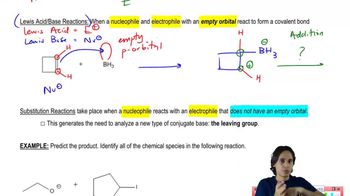
Nucleophiles and Electrophiles can react in Substitution Reactions.

Ethanol as a Solvent

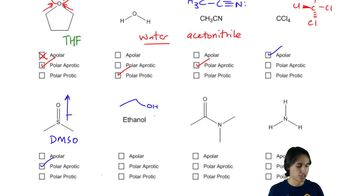
Ethanol is a polar protic solvent that can stabilize ions and facilitate nucleophilic substitution reactions. Its ability to donate hydrogen bonds makes it effective in solvolysis, as it can stabilize the carbocation formed in SN1 reactions or assist in the nucleophilic attack in SN2 reactions. The choice of solvent can significantly influence the reaction pathway and the products formed.
Recommended video:
Guided course
00:20
Identification of polarity in solvents