
Ch.6 - Alkyl Halides; Nucleophilic Substitution
Wade - Organic Chemistry 9th Edition
Wade9th EditionOrganic ChemistryISBN: 9780135213728Not the one you use?Change textbook
Chapter 6, Problem 40a,b

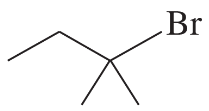
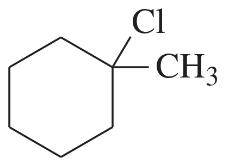
Give the substitution products expected from solvolysis of each compound by heating in ethanol.
(a)
(b)

Verified step by step guidance
1
Step 1: Identify the type of reaction. Solvolysis in ethanol typically proceeds via an SN1 mechanism, especially for tertiary alkyl halides or secondary alkyl halides with good leaving groups. The leaving group departs first, forming a carbocation intermediate.
Step 2: Analyze compound (a). The bromine atom is attached to a tertiary carbon, which is highly favorable for carbocation formation. Upon heating in ethanol, the bromine leaves, forming a tertiary carbocation. Ethanol, acting as a nucleophile, will attack the carbocation to form the substitution product.
Step 3: Analyze compound (b). The chlorine atom is attached to a secondary carbon in a cyclohexane ring. The chlorine leaves, forming a secondary carbocation. Ethanol will then attack the carbocation to form the substitution product. Consider possible rearrangements if the carbocation can stabilize further.
Step 4: Consider stereochemistry. For both compounds, the products may exhibit stereochemical outcomes depending on the attack of ethanol on the planar carbocation intermediate. This can lead to racemic mixtures if the carbocation is chiral.
Step 5: Summarize the substitution products. For compound (a), the product will be an ethyl ether derivative of the tertiary carbon. For compound (b), the product will be an ethyl ether derivative of the secondary carbon in the cyclohexane ring.

Verified video answer for a similar problem:

This video solution was recommended by our tutors as helpful for the problem above.
Video duration:
8m
Was this helpful?

Key Concepts

Here are the essential concepts you must grasp in order to answer the question correctly.

Solvolysis

Solvolysis is a type of nucleophilic substitution reaction where a solvent acts as the nucleophile. In organic chemistry, this often involves the reaction of alkyl halides with polar protic solvents like ethanol. The solvent can replace the leaving group (e.g., bromide) in the substrate, leading to the formation of substitution products.
Recommended video:
Guided course
08:16
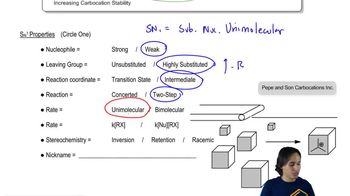
Understanding the properties of SN1.

Nucleophilic Substitution Mechanisms

Nucleophilic substitution can occur via two primary mechanisms: SN1 and SN2. The SN1 mechanism involves a two-step process where the leaving group departs first, forming a carbocation intermediate, followed by nucleophilic attack. In contrast, the SN2 mechanism is a one-step process where the nucleophile attacks the substrate simultaneously as the leaving group departs, leading to a concerted reaction.
Recommended video:
Guided course
01:47
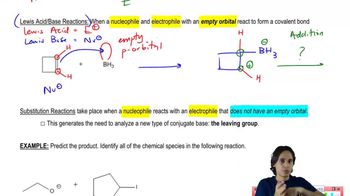
Nucleophiles and Electrophiles can react in Substitution Reactions.

Carbocation Stability

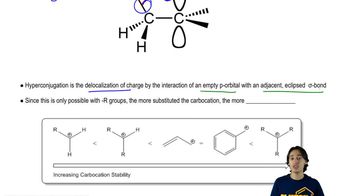
The stability of carbocations is crucial in determining the pathway of solvolysis reactions. Tertiary carbocations are more stable than secondary or primary ones due to hyperconjugation and inductive effects from surrounding alkyl groups. This stability influences whether the reaction will proceed via the SN1 or SN2 mechanism, affecting the substitution products formed.
Recommended video:
Guided course
05:58
Determining Carbocation Stability