Ch.6 - Alkyl Halides; Nucleophilic Substitution
Wade - Organic Chemistry 9th Edition
Wade9th EditionOrganic ChemistryISBN: 9780135213728Not the one you use?Change textbook
Chapter 6, Problem 41c

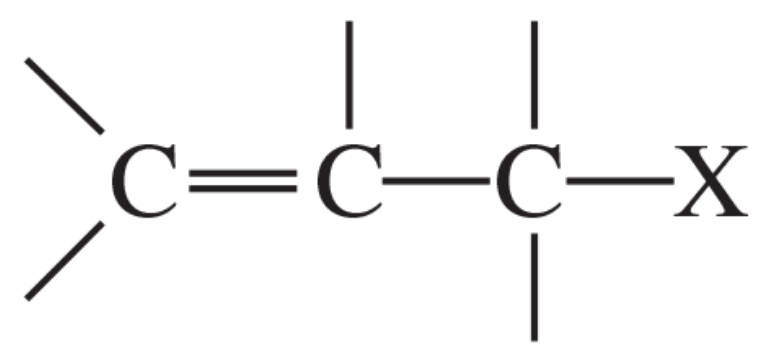
Allylic halides have the structure

c. Show the products expected from SN1 solvolysis of these halides in ethanol.

Verified step by step guidance
1
Step 1: Understand the structure of allylic halides. Allylic halides have a halogen atom (X) attached to a carbon atom that is adjacent to a double bond. This structure allows for resonance stabilization of the carbocation formed during the SN1 reaction.
Step 2: Analyze the mechanism of SN1 solvolysis. In an SN1 reaction, the halide group (X) leaves first, forming a carbocation intermediate. The carbocation is stabilized by resonance due to the adjacent double bond.
Step 3: Consider the solvent ethanol. Ethanol acts as a nucleophile in the solvolysis reaction, attacking the carbocation intermediate to form the final product. The nucleophilic attack can occur at different resonance-stabilized positions of the carbocation.
Step 4: Predict the products. The resonance stabilization of the carbocation allows for the formation of multiple products. Ethanol can attack at different positions, leading to regioisomers. For example, in the case of the allylic halides shown in the images, the products will include ethers formed by ethanol addition at the carbocation positions.
Step 5: Draw the resonance structures and products. For each allylic halide, draw the resonance-stabilized carbocation intermediates and show the products formed by ethanol attacking these intermediates. Ensure to include all possible regioisomers in the product set.

Verified video answer for a similar problem:

This video solution was recommended by our tutors as helpful for the problem above.
Video duration:
10m
Was this helpful?

Key Concepts

Here are the essential concepts you must grasp in order to answer the question correctly.

Allylic Halides

Allylic halides are organic compounds where a halogen atom is bonded to a carbon atom adjacent to a carbon-carbon double bond. This structure allows for unique reactivity patterns, particularly in nucleophilic substitution reactions, due to the resonance stabilization of the carbocation that can form during these reactions.
Recommended video:
Guided course
01:52
How to name alkyl halides

S<sub>N</sub>1 Mechanism

The S<sub>N</sub>1 mechanism is a type of nucleophilic substitution reaction characterized by a two-step process. The first step involves the formation of a carbocation intermediate after the leaving group departs, followed by the nucleophile attacking the carbocation. This mechanism is favored in polar protic solvents, such as ethanol, which stabilize the carbocation and the leaving group.
Recommended video:
Guided course
05:29
Creating Ribonucleosides

Solvolysis

Solvolysis refers to a chemical reaction in which the solvent acts as a nucleophile and participates in the reaction. In the context of S<sub>N</sub>1 reactions, solvolysis typically involves the solvent (like ethanol) attacking the carbocation formed after the leaving group departs, leading to the formation of an ether or alcohol product, depending on the solvent used.
Recommended video:
Guided course
08:16
Understanding the properties of SN1.