Ch.6 - Alkyl Halides; Nucleophilic Substitution
Wade - Organic Chemistry 9th Edition
Wade9th EditionOrganic ChemistryISBN: 9780135213728Not the one you use?Change textbook
Chapter 6, Problem 44b

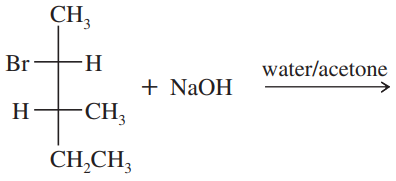
Draw perspective structures or Fischer projections for the substitution products of the following reactions.
(b) Chemical reaction showing a brominated compound reacting with NaOH in water/aceton, indicating substitution reaction products.

Verified step by step guidance
1
Step 1: Analyze the given reaction. The reactant is a brominated compound with a stereocenter, and the reaction involves NaOH in water/acetone. This suggests a substitution reaction, likely an SN2 mechanism due to the polar aprotic solvent (acetone).
Step 2: Understand the SN2 mechanism. In an SN2 reaction, the nucleophile (OH⁻) attacks the carbon bonded to the leaving group (Br) from the opposite side, leading to inversion of configuration at the stereocenter.
Step 3: Identify the stereochemistry of the reactant. The carbon bonded to Br is a stereocenter. The Fischer projection shows the substituents around this carbon: CH₃, H, CH₂CH₃, and Br. The inversion of configuration will swap the positions of Br and OH.
Step 4: Draw the product structure. Replace the Br group with OH in the Fischer projection, ensuring inversion of stereochemistry. The OH group will now occupy the position opposite to where Br was in the reactant.
Step 5: Verify the stereochemistry of the product. Ensure that the substituents are correctly positioned in the Fischer projection, maintaining the correct spatial arrangement after inversion. The final product will be the substituted alcohol with inverted configuration.

Verified video answer for a similar problem:

This video solution was recommended by our tutors as helpful for the problem above.
Video duration:
1m
Was this helpful?

Key Concepts

Here are the essential concepts you must grasp in order to answer the question correctly.

Nucleophilic Substitution Reactions

Nucleophilic substitution reactions involve the replacement of a leaving group (like bromine) in a molecule with a nucleophile (such as hydroxide ion from NaOH). This process can occur via two main mechanisms: SN1, which is unimolecular and involves carbocation formation, and SN2, which is bimolecular and involves a direct attack by the nucleophile. Understanding these mechanisms is crucial for predicting the products of the reaction.
Recommended video:
Guided course
01:47
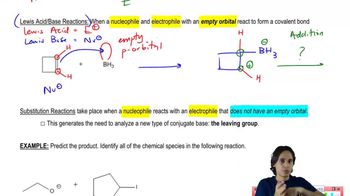
Nucleophiles and Electrophiles can react in Substitution Reactions.

Fischer Projections

Fischer projections are a two-dimensional representation of three-dimensional organic molecules, particularly useful for depicting stereochemistry in carbohydrates and amino acids. In these projections, vertical lines represent bonds that go back into the plane, while horizontal lines represent bonds that come out of the plane. Mastery of Fischer projections is essential for visualizing the spatial arrangement of substituents around chiral centers in the products of substitution reactions.
Recommended video:
Guided course
09:56
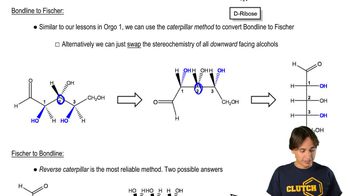
Monosaccharides - Drawing Fischer Projections

Stereochemistry

Stereochemistry refers to the study of the spatial arrangement of atoms in molecules and how this affects their chemical behavior. In substitution reactions, the configuration of chiral centers can change, leading to different stereoisomers. Recognizing the stereochemical outcomes of reactions, such as whether they produce enantiomers or diastereomers, is vital for accurately drawing the perspective structures or Fischer projections of the substitution products.
Recommended video:
1:38
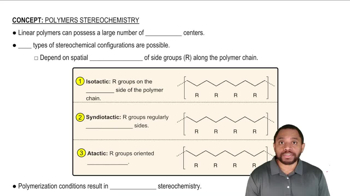
Polymer Stereochemistry Concept 1