Ch.6 - Alkyl Halides; Nucleophilic Substitution
Wade - Organic Chemistry 9th Edition
Wade9th EditionOrganic ChemistryISBN: 9780135213728Not the one you use?Change textbook
Chapter 6, Problem 45c,d

Predict the products of the following SN2 reactions.
(c) Chemical equation illustrating the reaction of sodium thiolate with bromoethane to predict product formation.


(d) Chemical equation showing a substitution reaction with reactants and products for SN2 reactions.

Verified step by step guidance
1
Step 1: Identify the type of reaction. Both reactions are SN2 reactions, which involve a single-step mechanism where the nucleophile attacks the electrophilic carbon and displaces the leaving group simultaneously.
Step 2: Analyze the reactants in reaction (c). The nucleophile is the phenylthiolate ion (C6H5S⁻), and the electrophile is ethyl bromide (CH3CH2Br). The bromine atom is the leaving group.
Step 3: Predict the product for reaction (c). The phenylthiolate ion will attack the electrophilic carbon in ethyl bromide, forming a new bond between the sulfur atom and the ethyl group. Bromine will be displaced as Br⁻.
Step 4: Analyze the reactants in reaction (d). The nucleophile is the acetylide ion (Na⁺:C≡CH), and the electrophile is a long-chain alkyl chloride (CH3(CH2)8CH2Cl). The chlorine atom is the leaving group.
Step 5: Predict the product for reaction (d). The acetylide ion will attack the electrophilic carbon in the alkyl chloride, forming a new bond between the terminal carbon of the acetylide and the alkyl chain. Chlorine will be displaced as Cl⁻.

Verified video answer for a similar problem:

This video solution was recommended by our tutors as helpful for the problem above.
Video duration:
5m
Was this helpful?

Key Concepts

Here are the essential concepts you must grasp in order to answer the question correctly.

S<sub>N</sub>2 Mechanism

The S<sub>N</sub>2 mechanism is a type of nucleophilic substitution reaction where a nucleophile attacks an electrophile, resulting in the simultaneous displacement of a leaving group. This reaction occurs in a single concerted step, leading to the inversion of configuration at the carbon center. It is characterized by a bimolecular rate law, meaning the rate depends on the concentration of both the nucleophile and the substrate.
Recommended video:
Guided course
05:29
Creating Ribonucleosides

Nucleophiles

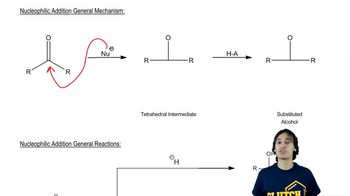
Nucleophiles are species that donate an electron pair to form a chemical bond in a reaction. In S<sub>N</sub>2 reactions, nucleophiles are typically negatively charged or neutral molecules with lone pairs of electrons. In the given reaction, sodium thiolate (S<sup>-</sup>) acts as the nucleophile, attacking the electrophilic carbon in bromoethane (CH<sub>3</sub>CH<sub>2</sub>Br) to form a new bond.
Recommended video:
Guided course
08:27
Nucleophilic Addition

Leaving Groups

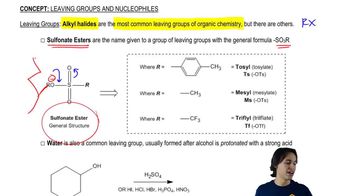
Leaving groups are atoms or groups that can depart from the substrate during a chemical reaction, taking with them the electrons from the bond they formed with the substrate. A good leaving group is typically stable after departure and can be a halide ion (like Br<sup>-</sup> in this case). The ability of a leaving group to leave easily is crucial for the success of S<sub>N</sub>2 reactions, as it influences the reaction rate and product formation.
Recommended video:
Guided course
07:22
The 3 important leaving groups to know.