Propose an SN1 mechanism for the solvolysis of 3-bromo-2,3-dimethylpentane in ethanol.
Ch.6 - Alkyl Halides; Nucleophilic Substitution
Chapter 6, Problem 20f
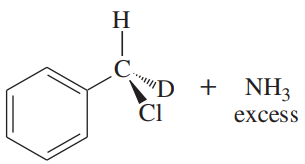
Draw a perspective structure or a Fischer projection for the products of the following SN2 reactions.
(f) 
Verified step by step guidance1
Identify the type of reaction: This is an SN2 reaction, which involves a backside attack by the nucleophile (NH3) on the carbon attached to the leaving group (Cl). SN2 reactions proceed with inversion of configuration at the stereocenter.
Analyze the reactants: The starting material is a chiral molecule with a benzyl group, a hydrogen atom, a deuterium atom (D), and a chlorine atom (Cl) attached to the central carbon. The chlorine atom is the leaving group, and NH3 is the nucleophile.
Determine the stereochemical outcome: In an SN2 reaction, the nucleophile (NH3) will attack the carbon from the side opposite to the leaving group (Cl). This results in the inversion of the stereochemistry at the chiral center.
Draw the product: Replace the chlorine atom with the NH2 group (from NH3) on the central carbon. Ensure that the stereochemistry is inverted, meaning the NH2 group will now be on the opposite side relative to the original position of the Cl atom.
Choose the representation: You can draw the product as either a perspective structure (using wedges and dashes to show 3D geometry) or as a Fischer projection. Ensure that the stereochemical inversion is clearly depicted in the chosen representation.

Verified video answer for a similar problem:
This video solution was recommended by our tutors as helpful for the problem above.
Video duration:
1mWas this helpful?
Key Concepts
Here are the essential concepts you must grasp in order to answer the question correctly.
S<sub>N</sub>2 Reaction Mechanism
The S<sub>N</sub>2 reaction mechanism is a type of nucleophilic substitution where a nucleophile attacks an electrophile, resulting in the simultaneous displacement of a leaving group. This mechanism is characterized by a single concerted step, leading to an inversion of configuration at the carbon center. Understanding this mechanism is crucial for predicting the stereochemical outcome of reactions involving chiral centers.
Recommended video:
Guided course
Heck Reaction Mechanism
Fischer Projection
A Fischer projection is a two-dimensional representation of a three-dimensional organic molecule, particularly useful for depicting stereochemistry. In this format, vertical lines represent bonds that project away from the viewer, while horizontal lines represent bonds that come towards the viewer. Fischer projections are essential for visualizing the spatial arrangement of substituents around chiral centers, especially in carbohydrate and amino acid chemistry.
Recommended video:
Guided course
Monosaccharides - Drawing Fischer Projections
Deuterium in Organic Chemistry
Deuterium is a stable isotope of hydrogen that contains one neutron, making it heavier than regular hydrogen. In organic chemistry, deuterium is often used as a tracer in reaction mechanisms or to study reaction pathways. Its presence can influence reaction rates and mechanisms, and understanding its role is important when analyzing reactions involving deuterated compounds, such as the one shown in the question.
Recommended video:
Guided course
What is an organic molecule?
Related Practice
Textbook Question
1
views
Textbook Question
Choose the member of each pair that will react faster by the SN1 mechanism.
c. n-propyl bromide or allyl bromide
d. 1-bromo-2,2-dimethylpropane or 2-bromopropane
Textbook Question
Draw a perspective structure or a Fischer projection for the products of the following SN2 reactions.
(a) trans-1-bromo-3-methylcyclopentane + KOH
(b) (R)-2-bromopentane + KCN
1
views
Textbook Question
Draw a perspective structure or a Fischer projection for the products of the following SN2 reactions.
(e)
1
views
Textbook Question
Draw a perspective structure or a Fischer projection for the products of the following SN2 reactions.
(c)
(d)
1
views
Textbook Question
Choose the member of each pair that will react faster by the SN1 mechanism.
a. 1-bromopropane or 2-bromopropane
b. 2-bromo-2-methylbutane or 2-bromo-3-methylbutane
4
views