
Ch.6 - Alkyl Halides; Nucleophilic Substitution
Wade - Organic Chemistry 9th Edition
Wade9th EditionOrganic ChemistryISBN: 9780135213728Not the one you use?Change textbook
Chapter 6, Problem 20a,b

Draw a perspective structure or a Fischer projection for the products of the following SN2 reactions.
(a) trans-1-bromo-3-methylcyclopentane + KOH
(b) (R)-2-bromopentane + KCN

Verified step by step guidance
1
Analyze the reaction type: This is an SN2 reaction, which involves a backside attack by the nucleophile, leading to inversion of configuration at the carbon center where substitution occurs. Keep this stereochemical inversion in mind for both parts of the problem.
For part (a): trans-1-bromo-3-methylcyclopentane + KOH: Identify the leaving group (Br) and the nucleophile (OH⁻). The OH⁻ will attack the carbon bonded to the bromine from the opposite side, displacing the bromine and inverting the stereochemistry at that carbon. Draw the resulting product with the hydroxyl group replacing the bromine and ensure the stereochemistry is inverted.
For part (b): (R)-2-bromopentane + KCN: Start by identifying the leaving group (Br) and the nucleophile (CN⁻). The CN⁻ will perform a backside attack on the carbon bonded to the bromine, displacing the bromine and inverting the stereochemistry. Since the starting compound is in the (R)-configuration, the product will have the (S)-configuration. Draw the product with the cyano group (-CN) replacing the bromine and ensure the stereochemistry is inverted.
For both parts, decide whether to use a perspective structure or a Fischer projection. For cyclic compounds like in part (a), a perspective structure is more common. For part (b), you can use either a perspective structure or a Fischer projection, depending on the context of the problem.
Double-check your drawings: Ensure that the stereochemistry is correctly inverted for both products and that the nucleophile has replaced the leaving group in each case. Verify that the products are consistent with the SN2 mechanism and the starting materials provided.

Verified video answer for a similar problem:

This video solution was recommended by our tutors as helpful for the problem above.
Video duration:
3m
Was this helpful?

Key Concepts

Here are the essential concepts you must grasp in order to answer the question correctly.

SN2 Reactions

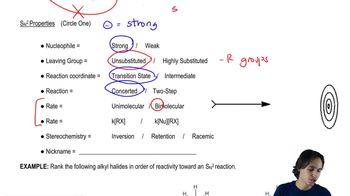
SN2 (Substitution Nucleophilic Bimolecular) reactions involve a nucleophile attacking an electrophile, resulting in the substitution of a leaving group. This reaction occurs in a single concerted step, where the nucleophile approaches the electrophile from the opposite side of the leaving group, leading to an inversion of configuration at the chiral center. Understanding the mechanism and stereochemical implications is crucial for predicting the products.
Recommended video:
Guided course
11:57
Understanding the properties of SN2.

Fischer Projections

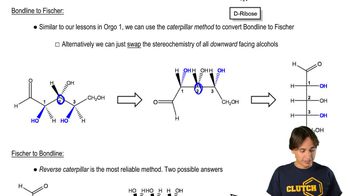
Fischer projections are a two-dimensional representation of three-dimensional organic molecules, particularly useful for depicting stereochemistry. In a Fischer projection, vertical lines represent bonds that project away from the viewer, while horizontal lines represent bonds that project towards the viewer. This format is essential for visualizing the stereochemical outcomes of reactions, especially for chiral compounds.
Recommended video:
Guided course
09:56
Monosaccharides - Drawing Fischer Projections

Stereochemistry

Stereochemistry is the study of the spatial arrangement of atoms in molecules and how this affects their chemical behavior. In the context of SN2 reactions, the stereochemical outcome is significant, as the inversion of configuration at a chiral center can lead to different optical isomers. Recognizing the stereochemical implications of reactants and products is vital for accurately drawing the resulting structures.
Recommended video:
1:38
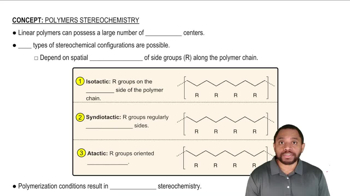
Polymer Stereochemistry Concept 1