

Ch.6 - Alkyl Halides; Nucleophilic Substitution
Wade - Organic Chemistry 9th Edition
Wade9th EditionOrganic ChemistryISBN: 9780135213728Not the one you use?Change textbook
Chapter 6, Problem 19a,b

For each pair of compounds, state which compound is the better SN2 substrate.
a. 2-methyl-1-iodopropane or tert-butyl iodide.
b. cyclohexyl bromide or 1-bromo-1-methylcyclohexane

Verified step by step guidance
1
Step 1: Recall the key factors that influence the SN2 reaction mechanism. SN2 reactions are bimolecular nucleophilic substitution reactions that occur in a single step. The rate of the reaction depends on steric hindrance around the electrophilic carbon and the leaving group. Less steric hindrance leads to a faster SN2 reaction.
Step 2: Analyze the first pair of compounds: 2-methyl-1-iodopropane and tert-butyl iodide. Compare the steric hindrance around the electrophilic carbon. In 2-methyl-1-iodopropane, the electrophilic carbon is primary, meaning it is attached to only one alkyl group, which minimizes steric hindrance. In tert-butyl iodide, the electrophilic carbon is tertiary, meaning it is attached to three alkyl groups, creating significant steric hindrance. Therefore, 2-methyl-1-iodopropane is the better SN2 substrate.
Step 3: Analyze the second pair of compounds: cyclohexyl bromide and 1-bromo-1-methylcyclohexane. Cyclohexyl bromide has a primary electrophilic carbon, as the bromine is attached to a carbon that is part of the cyclohexane ring but not substituted with additional groups. In contrast, 1-bromo-1-methylcyclohexane has a tertiary electrophilic carbon due to the methyl group attached to the same carbon as the bromine. The tertiary carbon in 1-bromo-1-methylcyclohexane creates steric hindrance, making cyclohexyl bromide the better SN2 substrate.
Step 4: Summarize the reasoning for both pairs. For SN2 reactions, primary carbons are preferred over tertiary carbons due to reduced steric hindrance. This principle applies to both pairs of compounds analyzed.
Step 5: Conclude that steric hindrance is the primary factor in determining the better SN2 substrate. For pair (a), 2-methyl-1-iodopropane is better. For pair (b), cyclohexyl bromide is better.

Verified video answer for a similar problem:

This video solution was recommended by our tutors as helpful for the problem above.
Video duration:
4m
Was this helpful?

Key Concepts

Here are the essential concepts you must grasp in order to answer the question correctly.

SN2 Mechanism

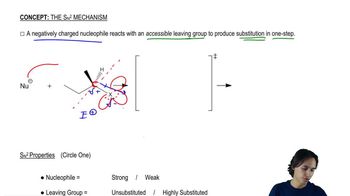
The SN2 mechanism is a type of nucleophilic substitution reaction where a nucleophile attacks an electrophile, resulting in the simultaneous displacement of a leaving group. This reaction is characterized by a single concerted step, leading to an inversion of configuration at the carbon center. The rate of the reaction depends on both the concentration of the nucleophile and the substrate, making sterics and electronic factors crucial for determining the reactivity.
Recommended video:
Guided course
08:33
Drawing the SN2 Mechanism

Steric Hindrance

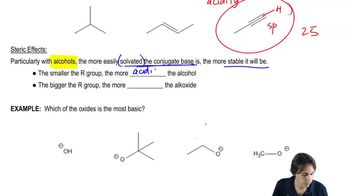
Steric hindrance refers to the prevention of chemical reactions due to the spatial arrangement of atoms within a molecule. In SN2 reactions, bulky groups around the electrophilic carbon can hinder the approach of the nucleophile, making the substrate less reactive. Therefore, substrates with less steric hindrance are generally better SN2 candidates, as they allow for easier access to the reactive site.
Recommended video:
Guided course
02:53
Understanding steric effects.

Leaving Group Ability

The ability of a leaving group to depart from a substrate is a critical factor in nucleophilic substitution reactions. Good leaving groups, such as iodide or bromide, stabilize the negative charge after leaving, facilitating the reaction. In comparing substrates, the quality of the leaving group can influence the overall reactivity, but steric factors often play a more significant role in determining which compound is a better SN2 substrate.
Recommended video:
Guided course
03:06
How to use the factors affecting acidity to predict leaving group ability.