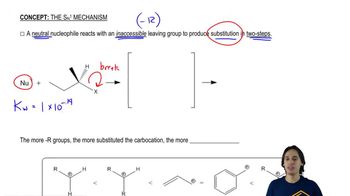
Propose an SN1 mechanism for the solvolysis of 3-bromo-2,3-dimethylpentane in ethanol.
Ch.6 - Alkyl Halides; Nucleophilic Substitution
Chapter 6, Problem 23a,b
Choose the member of each pair that will react faster by the SN1 mechanism.
a. 1-bromopropane or 2-bromopropane
b. 2-bromo-2-methylbutane or 2-bromo-3-methylbutane
Verified step by step guidance1
Step 1: Recall the key factors that influence the SN1 mechanism. The SN1 reaction proceeds via a two-step mechanism: (1) formation of a carbocation intermediate and (2) nucleophilic attack on the carbocation. The rate-determining step is the formation of the carbocation, so the stability of the carbocation is the most important factor. More stable carbocations form faster, leading to a faster SN1 reaction.
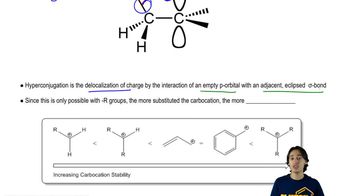
Step 2: Analyze part (a): Compare 1-bromopropane and 2-bromopropane. When the leaving group (bromine) departs, 1-bromopropane would form a primary carbocation, while 2-bromopropane would form a secondary carbocation. Secondary carbocations are more stable than primary carbocations due to inductive effects and hyperconjugation, so 2-bromopropane will react faster via the SN1 mechanism.
Step 3: Analyze part (b): Compare 2-bromo-2-methylbutane and 2-bromo-3-methylbutane. When the leaving group departs, 2-bromo-2-methylbutane would form a tertiary carbocation, while 2-bromo-3-methylbutane would form a secondary carbocation. Tertiary carbocations are more stable than secondary carbocations due to greater hyperconjugation and inductive effects, so 2-bromo-2-methylbutane will react faster via the SN1 mechanism.
Step 4: Consider other factors that might influence the reaction rate, such as the quality of the leaving group (bromine is a good leaving group in both cases) and the solvent (polar protic solvents favor SN1 reactions). However, in this problem, the carbocation stability is the dominant factor.
Step 5: Summarize the results: For part (a), 2-bromopropane reacts faster via the SN1 mechanism. For part (b), 2-bromo-2-methylbutane reacts faster via the SN1 mechanism. This conclusion is based on the relative stabilities of the carbocations formed in each case.

Verified video answer for a similar problem:
This video solution was recommended by our tutors as helpful for the problem above.
Video duration:
3mWas this helpful?
Key Concepts
Here are the essential concepts you must grasp in order to answer the question correctly.
SN1 Mechanism
The SN1 mechanism is a type of nucleophilic substitution reaction that occurs in two steps: first, the leaving group departs, forming a carbocation intermediate, followed by the nucleophile attacking the carbocation. The rate of the reaction depends primarily on the stability of the carbocation formed. More stable carbocations, such as tertiary or resonance-stabilized ones, will lead to faster reactions.
Recommended video:
Guided course
Drawing the SN1 Mechanism
Carbocation Stability
Carbocation stability is a crucial factor in determining the rate of SN1 reactions. Carbocations are classified as primary, secondary, or tertiary based on the number of alkyl groups attached to the positively charged carbon. Tertiary carbocations are the most stable due to hyperconjugation and inductive effects from surrounding alkyl groups, making them more favorable for SN1 reactions.
Recommended video:
Guided course
Determining Carbocation Stability
Substituent Effects
The presence and position of substituents on the carbon chain can significantly influence the reactivity in SN1 reactions. For example, branching near the reactive center can stabilize the carbocation formed during the reaction. In the given pairs, the structure of the bromopropanes will determine which compound can form a more stable carbocation, thus reacting faster via the SN1 mechanism.
Recommended video:
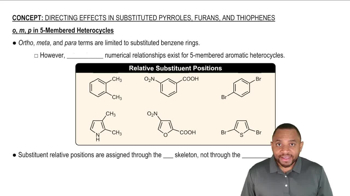
Directing Effects in Substituted Pyrroles, Furans, and Thiophenes Concept 1
Related Practice
Textbook Question
1
views
Textbook Question
Choose the member of each pair that will react faster by the SN1 mechanism.
c. n-propyl bromide or allyl bromide
d. 1-bromo-2,2-dimethylpropane or 2-bromopropane
Textbook Question
Draw a perspective structure or a Fischer projection for the products of the following SN2 reactions.
(e)
1
views
Textbook Question
Draw a perspective structure or a Fischer projection for the products of the following SN2 reactions.
(f)
1
views
Textbook Question
3-Bromocyclohexene is a secondary halide. It undergoes SN1 substitution about as fast as most tertiary halides. Use resonance structures to explain this enhanced reactivity.
2
views
Textbook Question
Choose the member of each pair that will react faster by the SN1 mechanism.
e. 2-iodo-2-methylbutane or tert-butyl chloride
f. 2-bromo-2-methylbutane or ethyl iodide
1
views