
Ozonolysis can be applied selectively to different types of carbon–carbon double bonds. The compound shown below contains two vinyl ether double bonds, which are electron-rich because of the electron-donating alkoxy groups. Ozone reacts more quickly with electron-rich double bonds and more slowly with hindered double bonds. At −78 °C, this compound quickly adds two equivalents of ozone. Immediate reduction of the ozonide gives a good yield of a single product. Show the expected ozonolyis product, and label the functional groups produced, some of which are not typical from ozonolysis of simple alkenes.
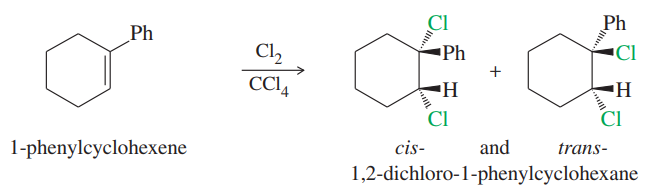
We have seen many examples where halogens add to alkenes with anti stereochemistry via the halonium ion mechanism. However, when 1-phenylcyclohexene reacts with chlorine in carbon tetrachloride, a mixture of the cis and trans isomers of the product is recovered. Propose a mechanism, and explain this lack of stereospecificity.

Verified step by step guidance
Verified video answer for a similar problem:
Key Concepts
Halonium Ion Mechanism
Stereochemistry of Alkenes
Regioselectivity and Stereoselectivity
The bulky borane 9-BBN was developed to enhance the selectivity of hydroboration. In this example, 9-BBN adds to the less hindered carbon with 99.3% regioselectivity, compared with only 57% for diborane.
a. Show the two organic products generated when the trialkylborane is oxidized with H2O2/NaOH.
An inexperienced graduate student treated dec-5-ene with borane in THF, placed the flask in a refrigerator, and left for a party. When he returned from the party, he discovered that the refrigerator was broken and that it had gotten quite warm inside. Although all the THF had evaporated from the flask, he treated the residue with basic hydrogen peroxide. To his surprise, he recovered a fair yield of decan-1-ol. Use a mechanism to show how this reaction might have occurred. (Hint: The addition of BH3 is reversible.)
Propose mechanisms to explain the opposite regiochemistry observed in the following two reactions.
The bulky borane 9-BBN was developed to enhance the selectivity of hydroboration. In this example, 9-BBN adds to the less hindered carbon with 99.3% regioselectivity, compared with only 57% for diborane.
b. 9-BBN is synthesized by adding BH3 across a symmetric, cyclic diene. What is the structure of the diene?
