
Ch.8 - Reactions of Alkenes
Wade - Organic Chemistry 9th Edition
Wade9th EditionOrganic ChemistryISBN: 9780135213728Not the one you use?Change textbook
Chapter 8, Problem 76

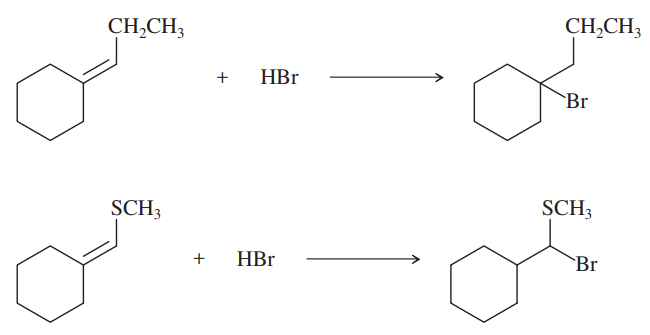
Propose mechanisms to explain the opposite regiochemistry observed in the following two reactions.
Two chemical reactions showing different regiochemistry with reactants and products labeled, involving alkenes and HBr.

Verified step by step guidance
1
Step 1: Analyze the first reaction. The alkene reacts with HBr, and the regiochemistry observed is Markovnikov addition. This means the bromine atom adds to the more substituted carbon of the double bond. The ethyl group (-CH2CH3) is an electron-donating group, which stabilizes the carbocation formed on the more substituted carbon during the reaction.
Step 2: Propose the mechanism for the first reaction. The alkene undergoes protonation by HBr, forming a carbocation intermediate. The carbocation forms on the more substituted carbon due to its greater stability (Markovnikov rule). Bromide ion then attacks the carbocation, leading to the observed product.
Step 3: Analyze the second reaction. The alkene reacts with HBr, but the regiochemistry observed is anti-Markovnikov addition. This means the bromine atom adds to the less substituted carbon of the double bond. The thiomethyl group (-SCH3) is an electron-withdrawing group, which destabilizes the carbocation on the more substituted carbon and favors a different pathway.
Step 4: Propose the mechanism for the second reaction. The thiomethyl group (-SCH3) can interact with the alkene and HBr to promote a radical mechanism. In this pathway, the bromine atom adds to the less substituted carbon due to the stability of the radical intermediate formed on the less substituted carbon. This is characteristic of anti-Markovnikov addition.
Step 5: Compare the two mechanisms. The first reaction follows a carbocation pathway (Markovnikov addition) due to the electron-donating ethyl group, while the second reaction follows a radical pathway (anti-Markovnikov addition) due to the electron-withdrawing thiomethyl group. The opposite regiochemistry is explained by the differing electronic effects of the substituents on the alkene.

Verified video answer for a similar problem:

This video solution was recommended by our tutors as helpful for the problem above.
Video duration:
2m
Was this helpful?

Key Concepts

Here are the essential concepts you must grasp in order to answer the question correctly.

Regiochemistry

Regiochemistry refers to the study of the distribution of products in a chemical reaction, particularly in terms of the position of substituents or functional groups in the resulting molecules. In reactions involving alkenes and electrophiles, such as the addition of HBr, the regioselectivity can lead to different products based on the stability of the carbocation intermediates formed during the reaction.
Recommended video:
Guided course
04:07
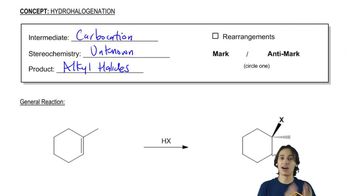
General properties of hydrohalogenation.

Carbocation Stability

Carbocation stability is a crucial factor in determining the outcome of electrophilic addition reactions. More stable carbocations, such as tertiary carbocations, are favored over less stable ones, like primary carbocations. The stability is influenced by factors such as hyperconjugation and inductive effects from adjacent alkyl groups, which can direct the regioselectivity of the reaction.
Recommended video:
Guided course
05:58
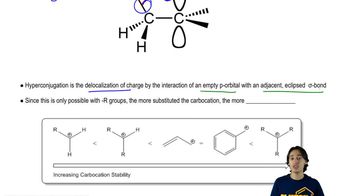
Determining Carbocation Stability

Markovnikov's Rule

Markovnikov's Rule states that in the addition of HX to an alkene, the hydrogen atom (H) will attach to the carbon with the greater number of hydrogen atoms already attached, while the halide (X) will attach to the carbon with fewer hydrogen atoms. This rule helps predict the major product in reactions involving alkenes and is essential for understanding the different regiochemistry observed in the provided reactions.
Recommended video:
Guided course
03:54
The 18 and 16 Electron Rule
Related Practice
Textbook Question

Ozonolysis can be applied selectively to different types of carbon–carbon double bonds. The compound shown below contains two vinyl ether double bonds, which are electron-rich because of the electron-donating alkoxy groups. Ozone reacts more quickly with electron-rich double bonds and more slowly with hindered double bonds. At −78 °C, this compound quickly adds two equivalents of ozone. Immediate reduction of the ozonide gives a good yield of a single product. Show the expected ozonolyis product, and label the functional groups produced, some of which are not typical from ozonolysis of simple alkenes.

1
views
Textbook Question

When styrene (vinylbenzene) is commercially polymerized, about 1–3% of 1,4-divinylbenzene is often added to the styrene. The incorporation of some divinylbenzene gives a polymer with more strength and better resistance to organic solvents. Explain how a very small amount of divinylbenzene has a marked effect on the properties of the polymer.

1
views
Textbook Question

The bulky borane 9-BBN was developed to enhance the selectivity of hydroboration. In this example, 9-BBN adds to the less hindered carbon with 99.3% regioselectivity, compared with only 57% for diborane.

a. Show the two organic products generated when the trialkylborane is oxidized with H2O2/NaOH.

1
views
Textbook Question

The cationic polymerization of isobutylene (2-methylpropene) is shown in Section 8-16A. Isobutylene is often polymerized under free-radical conditions. Propose a mechanism for the free-radical polymerization of isobutylene.

1
views
Textbook Question

We have seen many examples where halogens add to alkenes with anti stereochemistry via the halonium ion mechanism. However, when 1-phenylcyclohexene reacts with chlorine in carbon tetrachloride, a mixture of the cis and trans isomers of the product is recovered. Propose a mechanism, and explain this lack of stereospecificity.

2
views
Textbook Question

An inexperienced graduate student treated dec-5-ene with borane in THF, placed the flask in a refrigerator, and left for a party. When he returned from the party, he discovered that the refrigerator was broken and that it had gotten quite warm inside. Although all the THF had evaporated from the flask, he treated the residue with basic hydrogen peroxide. To his surprise, he recovered a fair yield of decan-1-ol. Use a mechanism to show how this reaction might have occurred. (Hint: The addition of BH3 is reversible.)

1
views