
Ch.8 - Reactions of Alkenes
Wade - Organic Chemistry 9th Edition
Wade9th EditionOrganic ChemistryISBN: 9780135213728Not the one you use?Change textbook
Chapter 8, Problem 79b

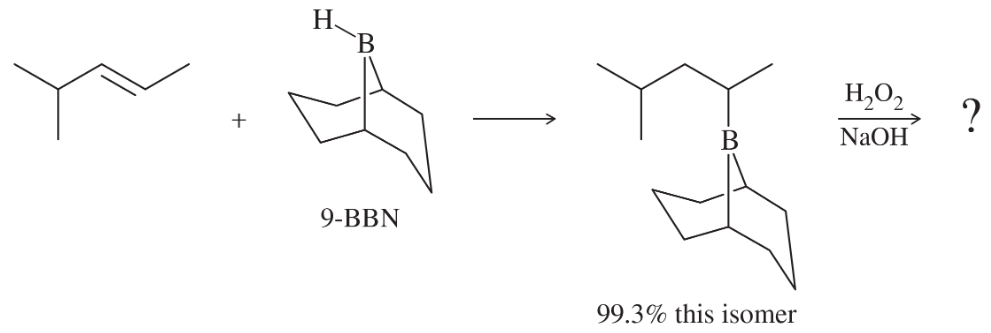
The bulky borane 9-BBN was developed to enhance the selectivity of hydroboration. In this example, 9-BBN adds to the less hindered carbon with 99.3% regioselectivity, compared with only 57% for diborane.

b. 9-BBN is synthesized by adding BH3 across a symmetric, cyclic diene. What is the structure of the diene?

Verified step by step guidance
1
Step 1: Understand the role of 9-BBN in hydroboration. 9-BBN is a bulky borane reagent that adds to the less hindered carbon of an alkene with high regioselectivity. This is due to steric hindrance, which prevents it from approaching the more substituted carbon.
Step 2: Analyze the synthesis of 9-BBN. The reagent is formed by adding BH₃ (borane) across a symmetric, cyclic diene. This reaction results in a bicyclic structure where boron is incorporated into the ring system.
Step 3: Identify the cyclic diene used to synthesize 9-BBN. The diene must be symmetric and cyclic to ensure the formation of the bicyclic structure. A common example is 1,5-cyclooctadiene, which reacts with BH₃ to form 9-BBN.
Step 4: Relate the structure of 9-BBN to its regioselectivity. The bulky bicyclic structure of 9-BBN ensures that it adds to the less hindered carbon of the alkene, as shown in the reaction where the boron adds to the terminal carbon of the alkene with 99.3% selectivity.
Step 5: Consider the final step of the reaction. After hydroboration, the organoborane intermediate undergoes oxidation with H₂O₂ and NaOH to form the alcohol product. The regioselectivity of the hydroboration step determines the position of the hydroxyl group in the final product.

Verified video answer for a similar problem:

This video solution was recommended by our tutors as helpful for the problem above.
Video duration:
5m
Was this helpful?

Key Concepts

Here are the essential concepts you must grasp in order to answer the question correctly.

Hydroboration

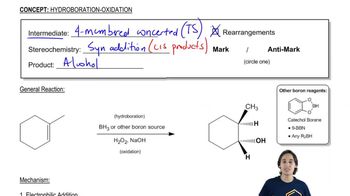
Hydroboration is a chemical reaction that involves the addition of borane (BH3) to alkenes, resulting in the formation of organoboranes. This reaction proceeds via a syn-addition mechanism, where the boron atom adds to the less substituted carbon atom of the alkene, leading to regioselectivity. The process is crucial in organic synthesis for creating alcohols through subsequent oxidation.
Recommended video:
Guided course
06:38
General properties of hydroboration-oxidation.

Regioselectivity

Regioselectivity refers to the preference of a chemical reaction to yield one structural isomer over others when multiple possibilities exist. In the case of hydroboration with 9-BBN, the reaction exhibits high regioselectivity (99.3%) for the less hindered carbon, which is significant for controlling the outcome of synthetic pathways in organic chemistry.
Recommended video:
Guided course
05:09
Heck Reaction

Diene Structure

A diene is a hydrocarbon that contains two double bonds. In the context of the question, the synthesis of 9-BBN involves the addition of borane across a symmetric cyclic diene, which provides a specific framework for the reaction. Understanding the structure of the diene is essential for predicting the regioselectivity and the final product of the hydroboration reaction.
Recommended video:
Guided course
04:43
Drawing MO Diagram for Dienes