Ch.8 - Reactions of Alkenes
Wade - Organic Chemistry 9th Edition
Wade9th EditionOrganic ChemistryISBN: 9780135213728Not the one you use?Change textbook
Chapter 8, Problem 46o

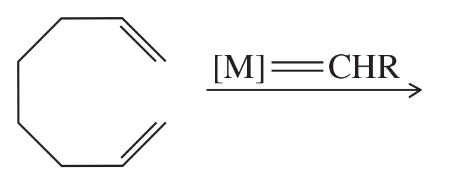
Predict the major products of the following reactions, and give the structures of any intermediates. Include stereochemistry where appropriate.
(o)

Verified step by step guidance
1
Step 1: Identify the type of reaction. The given reaction involves a compound with two double bonds reacting with a metal-carbene complex ([M]=CHR). This suggests a metathesis reaction, specifically ring-closing metathesis (RCM), which is commonly catalyzed by metal-carbene complexes.
Step 2: Analyze the structure of the starting material. The molecule contains two double bonds in a cyclic structure, which are positioned to undergo a ring-closing metathesis reaction. This reaction will form a new ring by connecting the two double bonds.
Step 3: Predict the intermediate. During the reaction, the metal-carbene complex interacts with one of the double bonds to form a metallacyclobutane intermediate. This intermediate rearranges to form a new double bond while releasing the metal-carbene catalyst.
Step 4: Determine the major product. The reaction will result in the formation of a smaller ring structure with a new double bond. The stereochemistry of the product will depend on the reaction conditions and the steric/electronic properties of the substituents.
Step 5: Consider stereochemistry. If the reaction conditions favor the formation of a specific stereoisomer (e.g., cis or trans configuration of the double bond), this should be noted. The final product will likely be a cyclic alkene with defined stereochemistry.

Verified video answer for a similar problem:

This video solution was recommended by our tutors as helpful for the problem above.
Video duration:
8m
Was this helpful?

Key Concepts

Here are the essential concepts you must grasp in order to answer the question correctly.

Electrophilic Addition Reactions

Electrophilic addition reactions involve the addition of an electrophile to a nucleophile, typically across a double bond. In the context of alkenes, the π bond is broken, allowing new σ bonds to form with the electrophile and nucleophile. Understanding this mechanism is crucial for predicting the products of reactions involving alkenes and other unsaturated compounds.
Recommended video:
Guided course
05:39
Features of Addition Mechanisms.

Stereochemistry

Stereochemistry refers to the study of the spatial arrangement of atoms in molecules and how this affects their chemical behavior. In reactions, stereochemistry can influence the formation of chiral centers and the resulting enantiomers or diastereomers. Recognizing stereochemical outcomes is essential for accurately predicting the products of organic reactions, especially when multiple stereoisomers are possible.
Recommended video:
1:38
Polymer Stereochemistry Concept 1

Reaction Intermediates

Reaction intermediates are transient species formed during the conversion of reactants to products in a chemical reaction. They often have distinct structures and properties that can influence the overall reaction pathway. Identifying and understanding these intermediates is vital for predicting the major products and mechanisms of organic reactions, as they can dictate the course and selectivity of the reaction.
Recommended video:
Guided course
04:31
Stability of Conjugated Intermediates