Ch.8 - Reactions of Alkenes
Wade - Organic Chemistry 9th Edition
Wade9th EditionOrganic ChemistryISBN: 9780135213728Not the one you use?Change textbook
Chapter 8, Problem 47a

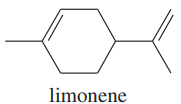
Limonene is one of the compounds that give lemons their tangy odor. Show the structures of the products expected when limonene reacts with an excess of each of these reagents.
Chemical structure of limonene, a compound contributing to the tangy odor of lemons.
a. borane in tetrahydrofuran, followed by basic hydrogen peroxide

Verified step by step guidance
1
Identify the functional groups in limonene: Limonene is a terpene with a characteristic double bond in its structure. This double bond is the site of reactivity in the reaction with borane.
Understand the hydroboration-oxidation reaction: This reaction involves two main steps. First, the addition of borane (BH3) to the double bond, followed by oxidation with hydrogen peroxide (H2O2) in a basic solution.
Predict the regioselectivity of hydroboration: In the hydroboration step, borane adds across the double bond in an anti-Markovnikov fashion, meaning the boron atom attaches to the less substituted carbon of the double bond.
Perform the oxidation step: The boron atom is replaced by a hydroxyl group (-OH) during the oxidation step with hydrogen peroxide in a basic medium, resulting in the formation of an alcohol.
Draw the final product: The final product will be an alcohol where the hydroxyl group is attached to the less substituted carbon of the original double bond in limonene, reflecting the anti-Markovnikov addition.

Verified video answer for a similar problem:

This video solution was recommended by our tutors as helpful for the problem above.
Video duration:
2m
Was this helpful?

Key Concepts

Here are the essential concepts you must grasp in order to answer the question correctly.

Limonene Structure and Reactivity

Limonene is a cyclic monoterpene with a double bond, which makes it reactive in various organic reactions. Understanding its structure is crucial for predicting the products of its reactions. The presence of the double bond allows for electrophilic addition reactions, where reagents can add across the double bond, leading to different functional groups in the products.
Recommended video:
Guided course
01:17
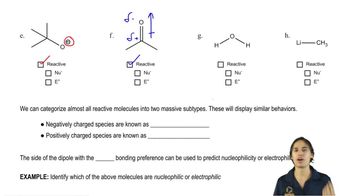
Reactivity of Molecules

Hydroboration-Oxidation Reaction

The hydroboration-oxidation reaction is a two-step process used to convert alkenes into alcohols. In the first step, borane (BH3) adds across the double bond of limonene, forming an organoborane intermediate. The subsequent oxidation with hydrogen peroxide in a basic medium converts the organoborane into an alcohol, typically resulting in anti-Markovnikov addition of water across the double bond.
Recommended video:
Guided course
06:38
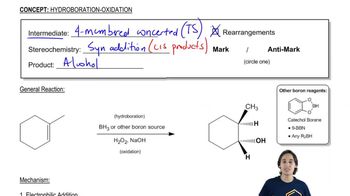
General properties of hydroboration-oxidation.

Stereochemistry of Reaction Products

Stereochemistry refers to the spatial arrangement of atoms in molecules and is crucial in determining the properties of the reaction products. The addition of reagents to limonene can lead to different stereoisomers, depending on the mechanism of the reaction. Understanding stereochemistry helps predict the specific configurations of the alcohol products formed after hydroboration-oxidation.
Recommended video:
1:38
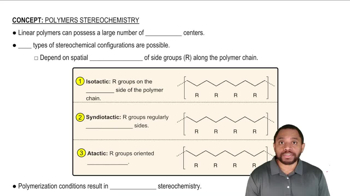
Polymer Stereochemistry Concept 1