Ch.8 - Reactions of Alkenes
Wade - Organic Chemistry 9th Edition
Wade9th EditionOrganic ChemistryISBN: 9780135213728Not the one you use?Change textbook
Chapter 8, Problem 47d

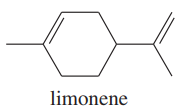
Limonene is one of the compounds that give lemons their tangy odor. Show the structures of the products expected when limonene reacts with an excess of each of these reagents.
Chemical structure of limonene, a compound contributing to the tangy odor of lemons.
d. a mixture of osmic acid and hydrogen peroxide

Verified step by step guidance
1
Step 1: Identify the functional groups in limonene. Limonene is a terpene with two double bonds: one in the cyclohexene ring and one in the isopropenyl group.
Step 2: Understand the reaction conditions. Osmic acid (OsO₄) in the presence of hydrogen peroxide is used for dihydroxylation, which adds hydroxyl groups (-OH) to the double bonds in a syn-addition manner.
Step 3: Predict the reaction at the cyclohexene double bond. Osmic acid will react with the double bond in the cyclohexene ring, forming a diol with hydroxyl groups added to the two carbons of the double bond.
Step 4: Predict the reaction at the isopropenyl double bond. Similarly, the double bond in the isopropenyl group will undergo dihydroxylation, resulting in another diol with hydroxyl groups added to the two carbons of this double bond.
Step 5: Combine the results. The final product will have two diols: one on the cyclohexene ring and one on the isopropenyl group, with hydroxyl groups added in a syn fashion to each double bond.

Verified video answer for a similar problem:

This video solution was recommended by our tutors as helpful for the problem above.
Video duration:
6m
Was this helpful?

Key Concepts

Here are the essential concepts you must grasp in order to answer the question correctly.

Limonene Structure and Properties

Limonene is a cyclic monoterpene with a distinctive structure characterized by a six-membered ring and a double bond. It is known for its citrus aroma and is commonly found in the peels of citrus fruits. Understanding its structure is crucial for predicting its reactivity with various reagents, as the presence of double bonds makes it susceptible to electrophilic addition reactions.
Recommended video:
1:19
Polymers Structure and Properties Concept 1

Osmic Acid and Hydrogen Peroxide Reaction

Osmic acid (OsO4) is a powerful oxidizing agent used in organic chemistry to convert alkenes into diols through syn-dihydroxylation. When combined with hydrogen peroxide, it enhances the oxidation process, leading to the formation of vicinal diols. This reaction is significant for understanding how limonene can be transformed into more complex structures through oxidation.
Recommended video:
3:55
Triacylglycerol Reactions: Hydrogenation Concept 1

Mechanism of Electrophilic Addition

Electrophilic addition is a fundamental reaction mechanism in organic chemistry where an electrophile reacts with a nucleophile, typically involving alkenes. In the case of limonene reacting with osmic acid and hydrogen peroxide, the double bond in limonene acts as a nucleophile, allowing the electrophilic osmic acid to add across the double bond, resulting in the formation of a diol. Understanding this mechanism is essential for predicting the products of the reaction.
Recommended video:
Guided course
05:39
Features of Addition Mechanisms.