Ch.8 - Reactions of Alkenes
Wade - Organic Chemistry 9th Edition
Wade9th EditionOrganic ChemistryISBN: 9780135213728Not the one you use?Change textbook
Chapter 8, Problem 46n

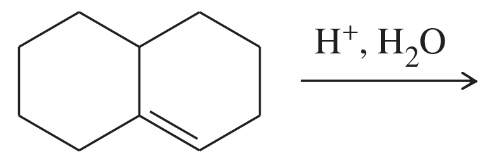
Predict the major products of the following reactions, and give the structures of any intermediates. Include stereochemistry where appropriate. n
(n)

Verified step by step guidance
1
Step 1: Analyze the reaction conditions. The presence of H⁺ and H₂O indicates an acid-catalyzed hydration reaction, which typically involves the addition of water across a double bond in an alkene.
Step 2: Identify the alkene in the structure. The double bond in the cyclohexene ring is the reactive site for the acid-catalyzed hydration.
Step 3: Protonation of the alkene occurs first. The π electrons of the double bond attack the H⁺, forming a carbocation intermediate. Consider the stability of the carbocation formed; tertiary carbocations are more stable than secondary or primary ones.
Step 4: Water acts as a nucleophile and attacks the carbocation intermediate, leading to the formation of an oxonium ion. This step introduces the hydroxyl group (-OH) to the molecule.
Step 5: Deprotonation of the oxonium ion occurs, resulting in the final alcohol product. Ensure stereochemistry is considered if the reaction creates chiral centers.

Verified video answer for a similar problem:

This video solution was recommended by our tutors as helpful for the problem above.
Video duration:
4m
Was this helpful?

Key Concepts

Here are the essential concepts you must grasp in order to answer the question correctly.

Electrophilic Addition

Electrophilic addition is a fundamental reaction mechanism in organic chemistry where an electrophile reacts with a nucleophile, resulting in the formation of a new bond. In the context of alkenes and alkynes, this process often involves the addition of acids or water across the double or triple bonds, leading to the formation of alcohols or other functional groups. Understanding this mechanism is crucial for predicting the products of reactions involving unsaturated hydrocarbons.
Recommended video:
Guided course
09:23
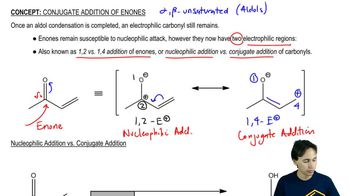
1,2 vs 1,4 Addition

Carbocation Stability

Carbocation stability is a key concept in organic reactions, particularly in electrophilic addition mechanisms. Carbocations are positively charged carbon species that can form as intermediates during reactions. Their stability is influenced by factors such as the degree of substitution (primary, secondary, tertiary) and resonance. More stable carbocations are more likely to form and dictate the pathway and products of the reaction, making it essential to consider their formation when predicting reaction outcomes.
Recommended video:
Guided course
05:58
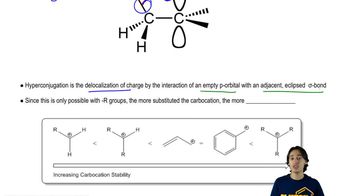
Determining Carbocation Stability

Stereochemistry

Stereochemistry refers to the spatial arrangement of atoms in molecules and how this affects their chemical behavior. In reactions involving chiral centers, the stereochemistry of the reactants can lead to the formation of specific stereoisomers in the products. When predicting products, it is important to consider stereochemical outcomes, especially in reactions that involve the addition of water or acids, as these can lead to different stereochemical configurations depending on the mechanism and intermediates involved.
Recommended video:
1:38
Polymer Stereochemistry Concept 1