Ch.8 - Reactions of Alkenes
Wade - Organic Chemistry 9th Edition
Wade9th EditionOrganic ChemistryISBN: 9780135213728Not the one you use?Change textbook
Chapter 8, Problem 46k

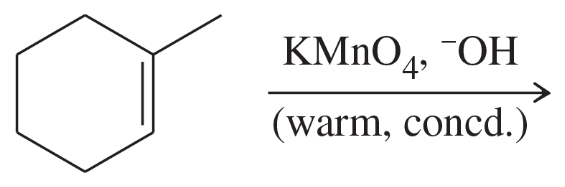
Predict the major products of the following reactions, and give the structures of any intermediates. Include stereochemistry where appropriate.
(k)

Verified step by step guidance
1
Step 1: Recognize the reagent and reaction conditions. Potassium permanganate (KMnO₄) under warm, concentrated conditions is a strong oxidizing agent. It typically cleaves double bonds in alkenes and oxidizes the resulting fragments to carboxylic acids or ketones.
Step 2: Analyze the structure of the starting material. The molecule contains a cyclohexene ring with one double bond. The double bond is the reactive site for KMnO₄ oxidation.
Step 3: Predict the cleavage of the double bond. KMnO₄ will break the double bond into two fragments. Each carbon involved in the double bond will be oxidized based on the substituents attached to it.
Step 4: Determine the oxidation products. If the carbons involved in the double bond are unsubstituted, they will be oxidized to carboxylic acids. If one of the carbons is substituted, it may form a ketone instead.
Step 5: Include stereochemistry and intermediates. Since this reaction involves oxidative cleavage, stereochemistry is not retained in the final products. The intermediate step involves the formation of a cyclic manganate ester, which then breaks down into the oxidized products.

Verified video answer for a similar problem:

This video solution was recommended by our tutors as helpful for the problem above.
Video duration:
6m
Was this helpful?

Key Concepts

Here are the essential concepts you must grasp in order to answer the question correctly.

Oxidation Reactions

Oxidation reactions involve the loss of electrons or an increase in oxidation state by a molecule, atom, or ion. In organic chemistry, these reactions often convert alkenes or alcohols into carbonyl compounds or carboxylic acids. The use of potassium permanganate (KMnO4) in a basic medium is a common method for oxidizing alkenes, leading to the formation of diols or carboxylic acids depending on the reaction conditions.
Recommended video:
Guided course
03:20
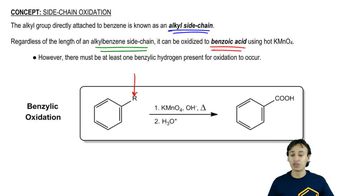
Benzylic Oxidation

Stereochemistry

Stereochemistry is the study of the spatial arrangement of atoms in molecules and how this affects their chemical behavior. In reactions involving chiral centers, the stereochemistry of the reactants can lead to different stereoisomers in the products. Understanding stereochemistry is crucial for predicting the outcomes of reactions, especially when intermediates are formed that may have specific stereochemical configurations.
Recommended video:
1:38
Polymer Stereochemistry Concept 1

Reaction Mechanisms

A reaction mechanism is a step-by-step description of how a chemical reaction occurs, detailing the formation and transformation of intermediates. In the case of the reaction shown, understanding the mechanism helps predict the major products formed from the alkene when treated with KMnO4. This includes identifying any intermediates, such as cyclic manganate esters, and the final products, which may include diols or carboxylic acids, depending on the reaction conditions.
Recommended video:
Guided course
02:16
Heck Reaction Mechanism