Ch.8 - Reactions of Alkenes
Wade - Organic Chemistry 9th Edition
Wade9th EditionOrganic ChemistryISBN: 9780135213728Not the one you use?Change textbook
Chapter 8, Problem 26

Predict the carbenoid addition products of the following reactions.
a. trans-hex-3-ene + CH2I2, Zn(Cu)
b. cis-hex-3-ene + CH2I2, Zn(Cu)

Verified step by step guidance
1
Step 1: Recognize the reaction type. The given reaction involves the Simmons-Smith reaction, which is a carbenoid addition reaction. In this reaction, CH2I2 reacts with Zn(Cu) to generate a carbenoid species (a methylene group, :CH2) that adds to the double bond of an alkene to form a cyclopropane ring.
Step 2: Analyze the stereochemistry of the starting alkene. For part (a), trans-hex-3-ene has substituents on opposite sides of the double bond, while for part (b), cis-hex-3-ene has substituents on the same side of the double bond. This stereochemistry will influence the stereochemistry of the cyclopropane product.
Step 3: Predict the product formation. The carbenoid (:CH2) generated by CH2I2 and Zn(Cu) adds to the double bond of the alkene, forming a cyclopropane ring. The stereochemistry of the alkene is preserved in the cyclopropane product due to the concerted nature of the reaction.
Step 4: For part (a), trans-hex-3-ene will yield a trans-cyclopropane product, where the substituents on the cyclopropane ring remain on opposite sides. For part (b), cis-hex-3-ene will yield a cis-cyclopropane product, where the substituents on the cyclopropane ring remain on the same side.
Step 5: Verify the stereochemistry of the products. Draw the structures of the cyclopropane products for both reactions, ensuring that the substituents on the cyclopropane ring match the stereochemistry of the original alkene (trans or cis).

Verified video answer for a similar problem:

This video solution was recommended by our tutors as helpful for the problem above.
Video duration:
7m
Was this helpful?

Key Concepts

Here are the essential concepts you must grasp in order to answer the question correctly.

Carbenoid Reactions

Carbenoid reactions involve the generation of carbenes, which are highly reactive species with a divalent carbon atom. In the presence of reagents like CH2I2 and Zn(Cu), carbenoids can facilitate the addition of a methylene group to alkenes, leading to the formation of cyclopropane derivatives or other products depending on the substrate's configuration.
Recommended video:
Guided course
05:09
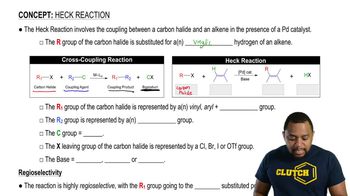
Heck Reaction

Stereochemistry of Alkenes

Stereochemistry refers to the spatial arrangement of atoms in molecules and is crucial in determining the outcome of reactions involving alkenes. The configuration of alkenes, whether cis or trans, influences the orientation of the reacting species and the resulting products, which can lead to different stereoisomers in the final product.
Recommended video:
1:38
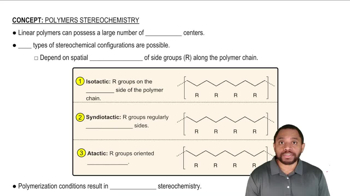
Polymer Stereochemistry Concept 1

Regioselectivity and Stereoselectivity

Regioselectivity and stereoselectivity are key concepts in organic reactions that describe how certain products are favored over others. In the context of the reactions provided, regioselectivity refers to the preference for the formation of specific structural isomers, while stereoselectivity indicates the preference for one stereoisomer over another, both of which are influenced by the starting alkene's configuration.
Recommended video:
Guided course
05:09
Heck Reaction