Ch.8 - Reactions of Alkenes
Wade - Organic Chemistry 9th Edition
Wade9th EditionOrganic ChemistryISBN: 9780135213728Not the one you use?Change textbook
Chapter 8, Problem 27c

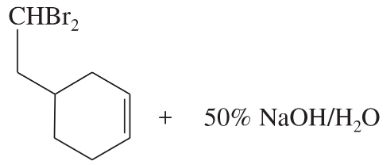
Predict the carbenoid addition products of the following reactions.
(c)

Verified step by step guidance
1
Step 1: Recognize that the reaction involves a dibromocarbene (:CBr2) formation. The presence of 50% NaOH and water indicates a basic medium, which facilitates the generation of the carbenoid intermediate from the CHBr2 group.
Step 2: In the basic medium, the hydroxide ion (OH⁻) deprotonates the CHBr2 group, leading to the formation of a bromoform intermediate (CHBr3). This intermediate then loses a bromide ion (Br⁻) to generate the carbenoid species (:CBr2).
Step 3: The carbenoid (:CBr2) reacts with the double bond in the cyclohexene ring via a cyclopropanation reaction. This reaction forms a three-membered cyclopropane ring fused to the cyclohexane ring, with two bromine atoms attached to the newly formed cyclopropane ring.
Step 4: Draw the product structure. The product will be a bicyclic compound where the cyclohexene ring is fused to a cyclopropane ring, and the two bromine atoms are attached to the cyclopropane ring.
Step 5: Verify the stereochemistry of the product. Since the reaction occurs via a concerted mechanism, the stereochemistry of the substituents on the double bond in the starting material will be preserved in the product.

Verified video answer for a similar problem:

This video solution was recommended by our tutors as helpful for the problem above.
Video duration:
7m
Was this helpful?

Key Concepts

Here are the essential concepts you must grasp in order to answer the question correctly.

Carbenoids

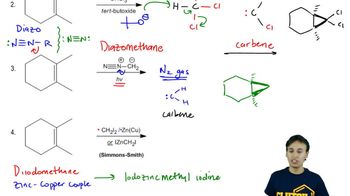
Carbenoids are reactive intermediates that resemble carbenes but are more stable and can be generated from certain precursors, such as halogenated compounds. They participate in various organic reactions, including cyclopropanation and addition reactions, where they can add across double bonds or react with nucleophiles. Understanding carbenoids is crucial for predicting the products of reactions involving halogenated compounds.
Recommended video:
Guided course
03:13
The Simmons-Smith reaction.

Nucleophilic Substitution Reactions

Nucleophilic substitution reactions involve the replacement of a leaving group in a molecule by a nucleophile. In the context of the given reaction, the hydroxide ion (from NaOH) acts as a nucleophile, attacking the electrophilic carbon attached to the bromine atoms. This concept is essential for understanding how the reaction proceeds and the types of products formed.
Recommended video:
Guided course
01:47
Nucleophiles and Electrophiles can react in Substitution Reactions.

Regioselectivity

Regioselectivity refers to the preference of a chemical reaction to occur at one location over another in a molecule. In the case of the reaction shown, the regioselectivity will determine which carbon atom in the double bond is attacked by the carbenoid or nucleophile. Recognizing regioselectivity is vital for predicting the major products of the reaction and understanding the underlying mechanisms.
Recommended video:
Guided course
05:09
Heck Reaction