
Textbook Question
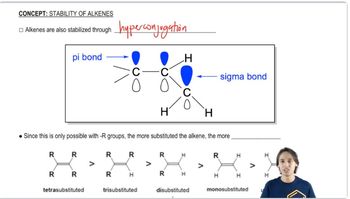
For each set of isomers, choose the isomer that you expect to be most stable and the isomer you expect to be least stable.
(c)
2
views


 Verified step by step guidance
 06:47
06:47
 04:28
04:28 00:44
00:44For each set of isomers, choose the isomer that you expect to be most stable and the isomer you expect to be least stable.
(c)
[FIGURE: KEY MECHANISM 7-1]
Show what happens in step 2 of the example if the solvent acts as a nucleophile (forming a bond to carbon) rather than as a base (removing a proton).
Explain why each of the following alkenes is stable or unstable.
(a) 1,2-dimethylcyclopentene
(b) trans-1,2-dimethylcyclopentene
(c) trans-3,4-dimethylcyclopentene
(d) trans-1,2-dimethylcyclodecene
For each set of isomers, choose the isomer that you expect to be most stable and the isomer you expect to be least stable.
(a)
SN1 substitution and E1 elimination frequently compete in the same reaction.
a. Propose a mechanism and predict the products for the solvolysis of 2-bromo-2,3,3-trimethylbutane in methanol.
Explain why each of the following alkenes is stable or unstable.
(h)
(i)