
Textbook Question
For each set of isomers, choose the isomer that you expect to be most stable and the isomer you expect to be least stable.
(c)
2
views

 Verified step by step guidance
 10:49
10:49
 08:09
08:09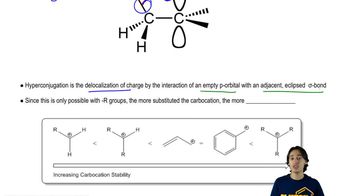 05:58
05:58For each set of isomers, choose the isomer that you expect to be most stable and the isomer you expect to be least stable.
(c)
[FIGURE: KEY MECHANISM 7-1]
Show what happens in step 2 of the example if the solvent acts as a nucleophile (forming a bond to carbon) rather than as a base (removing a proton).
The solvolysis of 2-bromo-3-methylbutane potentially can give several products, including both E1 and products from both the unrearranged carbocation and the rearranged carbocation. Mechanisms 6-6 and 7-2 show the products from the rearranged carbocation. Summarize all the possible products, showing which carbocation they come from and whether they are the products of E1 or reactions.
<IMAGES>
SN1 substitution and E1 elimination frequently compete in the same reaction.
b. Compare the function of the solvent (methanol) in the E1 and SN1 reactions.
Finish Solved Problem 7-3 by showing how the rearranged carbocations give the four products shown in the problem. Be careful when using curved arrows to show deprotonation and/or nucleophilic attack by the solvent. The curved arrows always show movement of electrons, not movement of protons or other species.
For each set of isomers, choose the isomer that you expect to be most stable and the isomer you expect to be least stable.
(b)