
Ch. 7 - Structure and Synthesis of Alkenes; Elimination
Wade - Organic Chemistry 9th Edition
Wade9th EditionOrganic ChemistryISBN: 9780135213728Not the one you use?Change textbook
Chapter 7, Problem 14a-d

Explain why each of the following alkenes is stable or unstable.
(a) 1,2-dimethylcyclopentene
(b) trans-1,2-dimethylcyclopentene
(c) trans-3,4-dimethylcyclopentene
(d) trans-1,2-dimethylcyclodecene

Verified step by step guidance
1
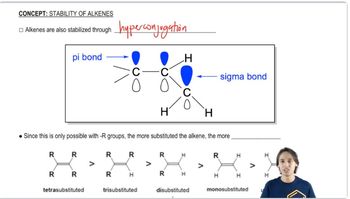
Step 1: Understand the concept of alkene stability. Alkene stability is influenced by factors such as the degree of substitution (more substituted alkenes are generally more stable due to hyperconjugation and inductive effects), steric strain, and ring strain in cyclic systems. Additionally, cis/trans isomerism can affect stability due to steric interactions between substituents.
Step 2: Analyze the stability of 1,2-dimethylcyclopentene. This alkene is a cyclic structure with a double bond in a five-membered ring. The methyl groups are attached to the carbons of the double bond. Since the ring is small, there is some ring strain, but the methyl groups increase substitution, which enhances stability. The absence of steric hindrance between the methyl groups makes this alkene relatively stable.
Step 3: Evaluate trans-1,2-dimethylcyclopentene. In this case, the methyl groups are on opposite sides of the double bond in a five-membered ring. The trans configuration in a small ring like cyclopentene introduces significant ring strain because the ring cannot easily accommodate the trans geometry. This makes the alkene less stable compared to its cis counterpart.
Step 4: Assess trans-3,4-dimethylcyclopentene. Here, the double bond is not directly substituted by the methyl groups, as they are located on carbons 3 and 4 of the ring. This means the double bond is less substituted, reducing stability. However, the trans configuration does not introduce as much strain in this case because the methyl groups are not directly on the double bond. The stability is moderate but lower than a more substituted alkene.
Step 5: Examine trans-1,2-dimethylcyclodecene. This alkene has a double bond in a ten-membered ring with trans methyl groups on the double bond carbons. Larger rings like cyclodecene can better accommodate the trans configuration, reducing ring strain. Additionally, the double bond is disubstituted, which enhances stability. Therefore, this alkene is relatively stable compared to smaller cyclic alkenes with trans configurations.

Verified video answer for a similar problem:

This video solution was recommended by our tutors as helpful for the problem above.
Video duration:
6m
Was this helpful?

Key Concepts

Here are the essential concepts you must grasp in order to answer the question correctly.

Stability of Alkenes

The stability of alkenes is influenced by factors such as steric strain, hyperconjugation, and the degree of substitution. More substituted alkenes are generally more stable due to increased hyperconjugation and reduced steric hindrance. Additionally, the presence of substituents can affect the overall strain in cyclic alkenes, impacting their stability.
Recommended video:
Guided course
04:28
Understanding trends of alkene stability.

Cyclic Alkene Strain

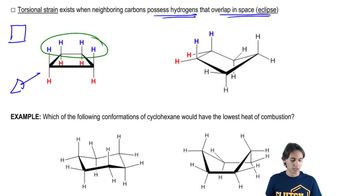
Cyclic alkenes can experience angle strain and torsional strain due to their ring structure. In smaller rings, such as cyclopentene, the bond angles deviate from the ideal tetrahedral angle of 109.5 degrees, leading to increased strain. The arrangement of substituents around the double bond also plays a crucial role in determining the stability of these cyclic structures.
Recommended video:
Guided course
02:00
What is torsional strain?

Geometric Isomerism in Alkenes

Geometric isomerism, particularly cis-trans isomerism, occurs due to the restricted rotation around the double bond in alkenes. In trans isomers, substituents are on opposite sides, which often leads to lower steric hindrance and increased stability compared to their cis counterparts. Understanding the geometric arrangement of substituents is essential for predicting the stability of alkenes.
Recommended video:
2:09
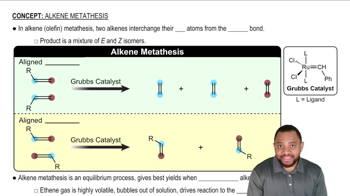
Alkene Metathesis Concept 1