Ch. 7 - Structure and Synthesis of Alkenes; Elimination
Wade - Organic Chemistry 9th Edition
Wade9th EditionOrganic ChemistryISBN: 9780135213728Not the one you use?Change textbook
Chapter 7, Problem 46c

For each alkene, indicate the direction of the dipole moment. For each pair, determine which compound has the larger dipole moment.
c. cis-1,2-dibromo-1,2-dichloroethene or cis-1,2-dichloroethene

Verified step by step guidance
1
Identify the molecular structure of each compound. For cis-1,2-dibromo-1,2-dichloroethene, the structure includes two bromine atoms and two chlorine atoms attached to a double-bonded carbon pair. For cis-1,2-dichloroethene, the structure includes two chlorine atoms attached to a double-bonded carbon pair.
Understand the concept of dipole moment. Dipole moment is a vector quantity that depends on the difference in electronegativity between atoms and the distance between them. It is represented by an arrow pointing from the positive to the negative end.
Determine the direction of the dipole moment for each compound. In cis-1,2-dibromo-1,2-dichloroethene, the dipole moments of the C-Br and C-Cl bonds will add up due to their orientation, resulting in a net dipole moment. In cis-1,2-dichloroethene, the dipole moments of the C-Cl bonds will also add up, but the overall dipole moment will be different due to the absence of bromine.
Compare the electronegativity of bromine and chlorine. Chlorine is more electronegative than bromine, which means that the C-Cl bond will have a stronger dipole moment than the C-Br bond. However, the presence of both bromine and chlorine in cis-1,2-dibromo-1,2-dichloroethene can lead to a larger overall dipole moment due to the combination of these dipoles.
Evaluate which compound has the larger dipole moment. Consider the vector addition of the dipole moments in each compound. The presence of both bromine and chlorine in cis-1,2-dibromo-1,2-dichloroethene suggests that it may have a larger dipole moment compared to cis-1,2-dichloroethene, which only has chlorine atoms contributing to the dipole moment.

Verified video answer for a similar problem:

This video solution was recommended by our tutors as helpful for the problem above.
Video duration:
4m
Was this helpful?

Key Concepts

Here are the essential concepts you must grasp in order to answer the question correctly.

Dipole Moment

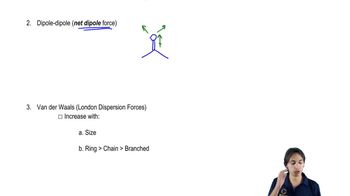
The dipole moment is a measure of the separation of positive and negative charges in a molecule. It is a vector quantity, having both magnitude and direction, and is influenced by the electronegativity of atoms and the geometry of the molecule. In alkenes, the dipole moment is determined by the difference in electronegativity between substituents and their spatial arrangement.
Recommended video:
Guided course
01:46
How dipole-dipole forces work.

Cis-Trans Isomerism

Cis-trans isomerism, also known as geometric isomerism, occurs in alkenes due to restricted rotation around the double bond. In cis isomers, similar or identical substituents are on the same side of the double bond, while in trans isomers, they are on opposite sides. This spatial arrangement affects the molecule's physical properties, including its dipole moment.
Recommended video:
Guided course
00:44
Is the following cyclohexane cis or trans?

Electronegativity

Electronegativity is the tendency of an atom to attract electrons towards itself in a chemical bond. It plays a crucial role in determining the polarity of bonds and, consequently, the dipole moment of a molecule. In the context of the given alkenes, the difference in electronegativity between bromine, chlorine, and hydrogen atoms will influence the direction and magnitude of the dipole moment.
Recommended video:
Guided course
1:47
Electronegativity