Ch. 7 - Structure and Synthesis of Alkenes; Elimination
Wade - Organic Chemistry 9th Edition
Wade9th EditionOrganic ChemistryISBN: 9780135213728Not the one you use?Change textbook
Chapter 7, Problem 46b

For each alkene, indicate the direction of the dipole moment. For each pair, determine which compound has the larger dipole moment
b. cis-1,2-dibromoethene or trans-2,3-dibromobut-2-ene

Verified step by step guidance
1
Identify the molecular structure of each compound: cis-1,2-dibromoethene and trans-2,3-dibromobut-2-ene. Draw their structures to visualize the arrangement of atoms and substituents.
Understand the concept of dipole moment: It is a vector quantity that depends on the difference in electronegativity between atoms and the distance between them. In alkenes, the dipole moment is influenced by the substituents attached to the double bond.
For cis-1,2-dibromoethene, note that both bromine atoms are on the same side of the double bond, which can lead to a net dipole moment due to the additive effect of the individual dipoles from each C-Br bond.
For trans-2,3-dibromobut-2-ene, observe that the bromine atoms are on opposite sides of the double bond, which can cause the dipoles to cancel each other out, resulting in a smaller net dipole moment.
Compare the net dipole moments: The cis isomer typically has a larger dipole moment than the trans isomer due to the alignment of dipoles in the same direction, leading to a greater overall dipole moment in the cis compound.

Verified video answer for a similar problem:

This video solution was recommended by our tutors as helpful for the problem above.
Video duration:
7m
Was this helpful?

Key Concepts

Here are the essential concepts you must grasp in order to answer the question correctly.

Dipole Moment

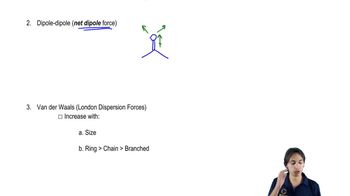
The dipole moment is a measure of the separation of positive and negative charges in a molecule. It is a vector quantity, having both magnitude and direction, and is influenced by the electronegativity of atoms and the geometry of the molecule. In alkenes, the dipole moment is affected by the presence and orientation of substituents around the double bond.
Recommended video:
Guided course
01:46
How dipole-dipole forces work.

Cis-Trans Isomerism

Cis-trans isomerism is a type of stereoisomerism where the relative orientation of functional groups within a molecule differs. In 'cis' isomers, similar groups are on the same side of the double bond, while in 'trans' isomers, they are on opposite sides. This orientation affects the molecule's physical properties, including its dipole moment, due to differences in spatial arrangement.
Recommended video:
Guided course
00:44
Is the following cyclohexane cis or trans?

Electronegativity and Bond Polarity

Electronegativity is the tendency of an atom to attract electrons in a bond. When two atoms with different electronegativities form a bond, the electrons are not shared equally, resulting in bond polarity. In alkenes, the presence of electronegative atoms like bromine can create polar bonds, contributing to the overall dipole moment of the molecule.
Recommended video:
Guided course
1:47
Electronegativity