
A double bond in a six-membered ring is usually more stable in an endocyclic position than in an exocyclic position. Hydrogenation data on two pairs of compounds follow. One pair suggests that the energy difference between endocyclic and exocyclic double bonds is about 9 kJ/mol. The other pair suggests an energy difference of about 5 kJ/mol. Which number do you trust as being more representative of the actual energy difference? Explain your answer.
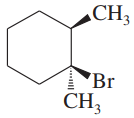
Predict the products of E1 elimination of the following compounds. Label the major products.
(a) 
Verified step by step guidance
Verified video answer for a similar problem:
Key Concepts
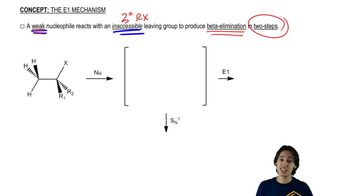
E1 Elimination Mechanism
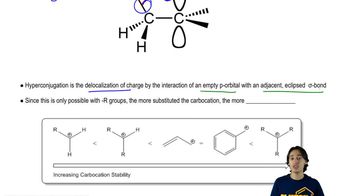
Carbocation Stability
Regioselectivity in Elimination Reactions
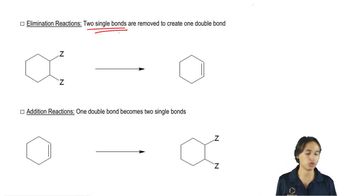
Predict the products formed by sodium hydroxide-promoted dehydrohalogenation of the following compounds. In each case, predict which will be the major product.
d. cis-1-bromo-2-methylcyclohexane
For each alkene, indicate the direction of the dipole moment. For each pair, determine which compound has the larger dipole moment.
c. cis-1,2-dibromo-1,2-dichloroethene or cis-1,2-dichloroethene
Predict the products formed by sodium hydroxide-promoted dehydrohalogenation of the following compounds. In each case, predict which will be the major product.
a. 1-bromobutane
b. 2-chlorobutane
c. 3-bromopentane
The energy difference between cis- and trans-but-2-ene is about 4 kJ/mol; however, the trans isomer of 4,4-dimethylpent-2-ene is nearly 16 kJ/mol more stable than the cis isomer. Explain this large difference.
Predict the products of E1 elimination of the following compounds. Label the major products.
(c)
