
Ch.4 - The Study of Chemical Reactions
Wade - Organic Chemistry 9th Edition
Wade9th EditionOrganic ChemistryISBN: 9780135213728Not the one you use?Change textbook
Chapter 4, Problem 45a

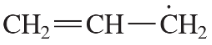
Draw the important resonance forms of the following free radicals.
a.

Verified step by step guidance
1
Identify the structure of the given free radical: CH2=CH—⋅CH2. The radical is located on the terminal carbon of the allyl group.
Recognize that resonance involves the delocalization of electrons. In this case, the unpaired electron on the terminal carbon can interact with the π-electrons of the double bond.
Draw the first resonance structure by moving the π-electrons of the C=C double bond towards the carbon with the unpaired electron, forming a new π-bond between the central carbon and the terminal carbon.
As a result of the electron movement, the central carbon now has an unpaired electron. Draw the second resonance structure showing this new distribution of electrons.
Ensure that all resonance structures maintain the same number of unpaired electrons and that the overall charge of the molecule remains unchanged. The resonance structures should be depicted with a double-headed arrow between them to indicate resonance.

Verified video answer for a similar problem:

This video solution was recommended by our tutors as helpful for the problem above.
Video duration:
3m
Was this helpful?

Key Concepts

Here are the essential concepts you must grasp in order to answer the question correctly.

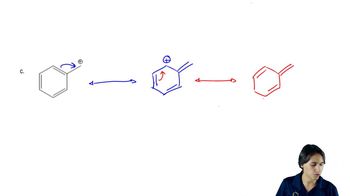
Resonance

Resonance in organic chemistry refers to the delocalization of electrons within a molecule, which can be represented by multiple structures called resonance forms. These forms illustrate different possible distributions of electrons, particularly in pi bonds or lone pairs, that contribute to the overall hybrid structure of the molecule. Understanding resonance is crucial for predicting the stability and reactivity of molecules.
Recommended video:
Guided course
03:04
Drawing Resonance Structures

Free Radicals

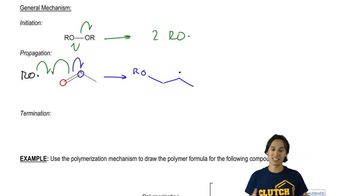
Free radicals are atoms or molecules that contain an unpaired electron, making them highly reactive. In organic chemistry, free radicals can participate in various reactions, such as addition or substitution, due to their tendency to pair their unpaired electron. Recognizing the presence of a free radical is essential for understanding its potential resonance forms and reactivity.
Recommended video:
Guided course
03:28
The mechanism of Radical Polymerization.

Allylic Position

The allylic position refers to the carbon atom adjacent to a carbon-carbon double bond. In the context of resonance, an allylic radical can stabilize through resonance by delocalizing the unpaired electron over the pi system of the double bond. This delocalization often results in multiple resonance forms, which are important for understanding the stability and reactivity of allylic radicals.
Recommended video:
1:26
Reactions at the Allylic Position Concept 1