Ch.4 - The Study of Chemical Reactions
Wade - Organic Chemistry 9th Edition
Wade9th EditionOrganic ChemistryISBN: 9780135213728Not the one you use?Change textbook
Chapter 4, Problem 45c,d

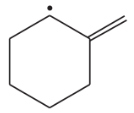
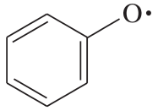
Draw the important resonance forms of the following free radicals.
(c)
(d)

Verified step by step guidance
1
Identify the free radical in the given structure. For CH3COO⋅, the radical is on the oxygen atom. For the cyclohexene radical, the radical is on the carbon atom adjacent to the double bond.
For CH3COO⋅, consider the resonance between the radical on the oxygen and the carbonyl group. The lone electron on the oxygen can form a double bond with the carbon, while the π bond of the carbonyl group can shift to the oxygen, creating a new radical site.
Draw the resonance structure for CH3COO⋅: Move the lone electron from the oxygen to form a double bond with the carbon, and move the π bond electrons of the carbonyl group to the oxygen, resulting in a structure with a radical on the carbonyl oxygen.
For the cyclohexene radical, consider the resonance involving the π bond. The radical electron can pair with one of the π electrons, forming a new π bond, while the other π electron moves to the adjacent carbon, creating a new radical site.
Draw the resonance structure for the cyclohexene radical: Shift the radical electron to form a double bond with the adjacent carbon, and move one of the π electrons to the next carbon, resulting in a new radical site on the carbon adjacent to the original double bond.

Verified video answer for a similar problem:

This video solution was recommended by our tutors as helpful for the problem above.
Video duration:
4m
Was this helpful?

Key Concepts

Here are the essential concepts you must grasp in order to answer the question correctly.

Resonance Structures

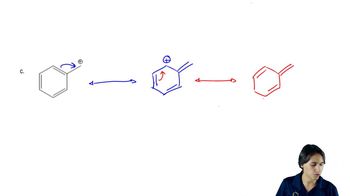
Resonance structures are different ways of drawing the same molecule that illustrate the delocalization of electrons. They help in understanding the stability and reactivity of molecules, particularly in cases where a single Lewis structure cannot adequately represent the electron distribution. In free radicals, resonance can stabilize the unpaired electron by allowing it to be shared across multiple atoms.
Recommended video:
Guided course
03:04
Drawing Resonance Structures

Free Radicals

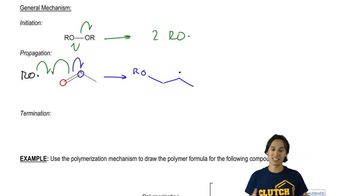
Free radicals are species that contain an unpaired electron, making them highly reactive. They can be formed through various processes, including the breaking of covalent bonds. Understanding the nature of free radicals is crucial for predicting their behavior in chemical reactions, as they often seek to pair their unpaired electron by reacting with other molecules.
Recommended video:
Guided course
03:28
The mechanism of Radical Polymerization.

Stability of Radicals

The stability of free radicals is influenced by their structure and the presence of substituents. Generally, radicals are more stable when they are tertiary (attached to three other carbon atoms) compared to secondary or primary radicals. This stability can be explained by hyperconjugation and resonance effects, which help to delocalize the unpaired electron, reducing the overall energy of the radical.
Recommended video:
Guided course
03:43
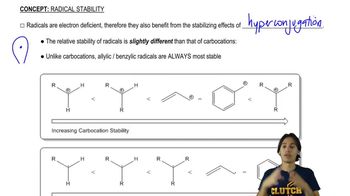
The radical stability trend.