Ch.4 - The Study of Chemical Reactions
Wade - Organic Chemistry 9th Edition
Wade9th EditionOrganic ChemistryISBN: 9780135213728Not the one you use?Change textbook
Chapter 4, Problem 43(3)c,d

For each alkane,
3. which monobrominated derivatives could you form in good yield by free-radical bromination?
c. 2-methylpentane
d. 2,2,3,3-tetramethylbutane

Verified step by step guidance
1
Step 1: Understand the concept of free-radical bromination. Free-radical bromination is a reaction where bromine (Br₂) reacts with an alkane in the presence of heat or light to form a monobrominated product. Bromine selectively reacts with the most stable radical intermediate, which is typically the carbon with the highest degree of substitution (tertiary > secondary > primary).
Step 2: Analyze the structure of 2-methylpentane. Draw the structure of 2-methylpentane, which has a main chain of five carbons with a methyl group attached to the second carbon. Identify all unique hydrogen atoms based on their positions (primary, secondary, or tertiary).
Step 3: Determine the possible monobrominated products for 2-methylpentane. Replace one hydrogen atom at a time with a bromine atom, considering the unique positions of hydrogens. Focus on the most substituted carbons (secondary or tertiary) for the major product, as bromine prefers to react at these sites due to the stability of the intermediate radical.
Step 4: Analyze the structure of 2,2,3,3-tetramethylbutane. Draw the structure of 2,2,3,3-tetramethylbutane, which has a central butane chain with two methyl groups attached to both the second and third carbons. Identify all unique hydrogen atoms based on their positions.
Step 5: Determine the possible monobrominated products for 2,2,3,3-tetramethylbutane. Replace one hydrogen atom at a time with a bromine atom. Note that all hydrogens in this molecule are equivalent (primary hydrogens), so only one monobrominated product is possible. This is because the molecule is highly symmetrical, and bromination at any hydrogen will yield the same product.

Verified video answer for a similar problem:

This video solution was recommended by our tutors as helpful for the problem above.
Video duration:
6m
Was this helpful?

Key Concepts

Here are the essential concepts you must grasp in order to answer the question correctly.

Free-Radical Bromination

Free-radical bromination is a reaction mechanism where bromine reacts with alkanes in the presence of heat or light, leading to the formation of brominated products. This process involves the generation of bromine radicals, which abstract hydrogen atoms from the alkane, resulting in the formation of alkyl radicals that can further react with bromine to yield monobrominated derivatives.
Recommended video:
Guided course
05:20
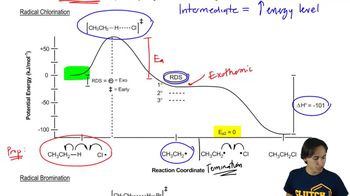
Using the Hammond Postulate to describe radical bromination.

Selectivity in Bromination

Selectivity in bromination refers to the preference of bromine radicals to abstract hydrogen atoms from certain positions in an alkane, influenced by the stability of the resulting alkyl radicals. More stable radicals, such as tertiary radicals, are favored, leading to higher yields of specific monobrominated products. Understanding this selectivity is crucial for predicting the products formed during the reaction.
Recommended video:
Guided course
00:54
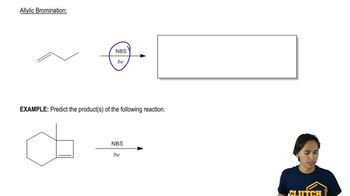
Mechanism of Allylic Bromination.

Monobrominated Derivatives

Monobrominated derivatives are organic compounds formed when one hydrogen atom in an alkane is replaced by a bromine atom. The position of bromination can vary, leading to different structural isomers. Identifying the possible monobrominated derivatives for a given alkane involves analyzing the structure to determine where bromination can occur, considering factors like steric hindrance and radical stability.
Recommended video:
Guided course
02:49
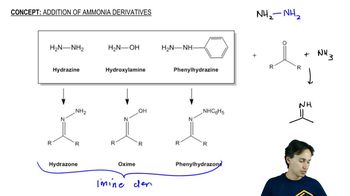
Ammonia Derivatives