Ch.4 - The Study of Chemical Reactions
Wade - Organic Chemistry 9th Edition
Wade9th EditionOrganic ChemistryISBN: 9780135213728Not the one you use?Change textbook
Chapter 4, Problem 43(2)a,b

For each alkane,
2. determine whether free-radical chlorination would be a good way to make any of these monochlorinated derivatives. Will the reaction give mostly one major product?
a. Cyclopentane
b. Methylcyclopentane

Verified step by step guidance
1
Step 1: Understand the concept of free-radical chlorination. Free-radical chlorination is a reaction where chlorine radicals replace hydrogen atoms in an alkane to form alkyl chlorides. The reaction proceeds through three steps: initiation, propagation, and termination. The selectivity of the reaction depends on the type of hydrogen being replaced (primary, secondary, or tertiary). Tertiary hydrogens are the most reactive, followed by secondary, and then primary hydrogens.
Step 2: Analyze cyclopentane. Cyclopentane is a cyclic alkane with all hydrogens being equivalent. Since all hydrogens are equivalent, free-radical chlorination will produce only one monochlorinated product. This makes free-radical chlorination a good method for synthesizing a single product in this case.
Step 3: Analyze methylcyclopentane. Methylcyclopentane is a substituted cyclopentane with a methyl group attached. The hydrogens in this molecule are not equivalent. There are secondary hydrogens on the cyclopentane ring and primary hydrogens on the methyl group. Free-radical chlorination will preferentially replace the secondary hydrogens because they are more reactive than primary hydrogens. However, multiple products can still form due to the presence of different types of hydrogens.
Step 4: Determine if the reaction will give mostly one major product for methylcyclopentane. Since secondary hydrogens are more reactive, the reaction will favor chlorination at the secondary positions, but some chlorination at the primary positions of the methyl group will also occur. This means the reaction will not give mostly one major product, as multiple products are possible.
Step 5: Summarize the findings. For cyclopentane, free-radical chlorination is a good method to produce a single monochlorinated derivative because all hydrogens are equivalent. For methylcyclopentane, free-radical chlorination is less selective and will produce a mixture of products, making it less ideal for synthesizing a single major product.

Verified video answer for a similar problem:

This video solution was recommended by our tutors as helpful for the problem above.
Video duration:
1m
Was this helpful?

Key Concepts

Here are the essential concepts you must grasp in order to answer the question correctly.

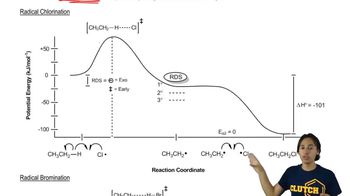
Free-Radical Chlorination

Free-radical chlorination is a reaction where chlorine reacts with alkanes to form chlorinated products through a radical mechanism. This process involves three main steps: initiation, propagation, and termination. The reaction typically leads to a mixture of products, but the distribution can vary based on the structure of the alkane and the stability of the resulting radicals.
Recommended video:
Guided course
03:03
Using the Hammond Postulate to describe radical chlorination.

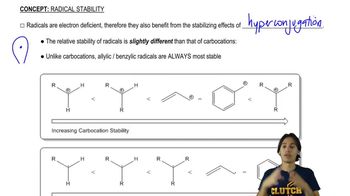
Radical Stability

The stability of radicals is crucial in determining the outcome of free-radical chlorination. Tertiary radicals are more stable than secondary, which are more stable than primary radicals. This stability influences the likelihood of forming specific chlorinated products, as more stable radicals are formed preferentially during the reaction.
Recommended video:
Guided course
03:43
The radical stability trend.

Selectivity in Chlorination

Selectivity in chlorination refers to the tendency of the reaction to produce one major product over others. Factors such as the structure of the alkane and the presence of different types of hydrogen atoms affect this selectivity. In some cases, like with cyclopentane and methylcyclopentane, the reaction may yield a predominant product due to the formation of more stable radicals.
Recommended video:
Guided course
03:03
Using the Hammond Postulate to describe radical chlorination.