
Textbook Question
Use the information in Table 4-2 (p. 167) to rank the following radicals in decreasing order of stability.
1
views

 Verified step by step guidance
 04:09
04:09
 04:38
04:38 02:16
02:16Use the information in Table 4-2 (p. 167) to rank the following radicals in decreasing order of stability.
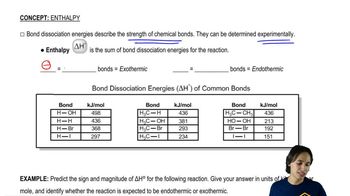
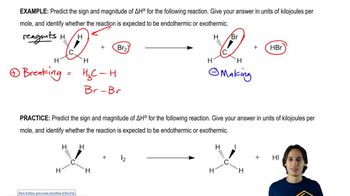
Use bond-dissociation enthalpies (Table 4-2, p. 167) to calculate values of ΔH° for the following reactions.
a. CH3—CH3 + I2 → CH3CH2I + HI
Use bond-dissociation enthalpies (Table 4-2, p. 167) to calculate values of ΔH° for the following reactions.
c. (CH3)3C—OH + HCl → (CH3)3C—Cl + H2O
For each alkane, which monobrominated derivatives could you form in good yield by free-radical bromination?
a. Cyclopentane
b. Methylcyclopentnae
For each alkane,
2. determine whether free-radical chlorination would be a good way to make any of these monochlorinated derivatives. Will the reaction give mostly one major product?
a. Cyclopentane
b. Methylcyclopentane
Use bond-dissociation enthalpies (Table 4-2, p. 167) to calculate values of ΔH° for the following reactions.
b. CH3CH2Cl + HI → CH3CH2I + HCl