Ch.3 - Structure and Stereochemistry of Alkanes
Wade - Organic Chemistry 9th Edition
Wade9th EditionOrganic ChemistryISBN: 9780135213728Not the one you use?Change textbook
Chapter 3, Problem 28

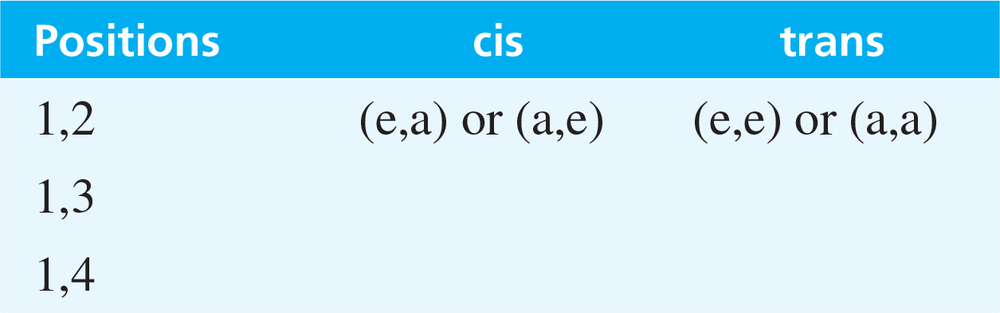
Use your results from Problem 3-27 to complete the following table. Each entry shows the positions of two groups arranged as shown. For example, two groups that are trans on adjacent carbons (trans-1,2) must be both equatorial (e,e) or both axial (a,a).

Verified step by step guidance
1
Understand the concept of stereochemistry and conformational analysis, focusing on the terms 'axial' and 'equatorial' positions in cyclohexane rings.
Recall that in cyclohexane, substituents can be positioned either axially (parallel to the axis of the ring) or equatorially (around the equator of the ring). This affects the stability of the molecule.
Consider the stereochemical relationship between substituents on adjacent carbons. For trans-1,2 substituents, both groups must be in the same type of position (either both axial or both equatorial) to maintain the trans configuration.
Apply the same logic to other configurations such as cis-1,2, trans-1,3, and cis-1,3, considering how the positions (axial/equatorial) affect the stereochemistry and stability of the molecule.
Use your understanding of these principles to fill in the table, ensuring that each pair of substituents is correctly assigned to either axial or equatorial positions based on their stereochemical relationship.

Verified video answer for a similar problem:

This video solution was recommended by our tutors as helpful for the problem above.
Video duration:
5m
Was this helpful?

Key Concepts

Here are the essential concepts you must grasp in order to answer the question correctly.

Cis-Trans Isomerism

Cis-trans isomerism refers to the arrangement of substituents around a double bond or a ring structure. In cis isomers, substituents are on the same side, while in trans isomers, they are on opposite sides. This concept is crucial for understanding how the spatial arrangement affects the stability and properties of molecules, particularly in cyclohexane chair conformations.
Recommended video:
Guided course
00:44
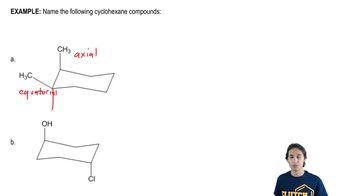
Is the following cyclohexane cis or trans?

Cyclohexane Chair Conformation

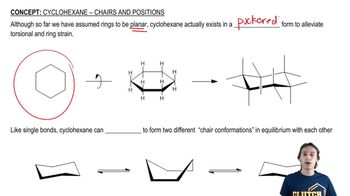
Cyclohexane can adopt a chair conformation, which is the most stable due to minimized steric strain. In this conformation, substituents can occupy axial or equatorial positions. Axial positions are perpendicular to the ring plane, while equatorial positions are parallel, affecting the molecule's stability and reactivity. Understanding this helps in predicting the preferred arrangement of groups in cis-trans isomers.
Recommended video:
Guided course
01:05
What is a chair conformation?

Axial and Equatorial Positions

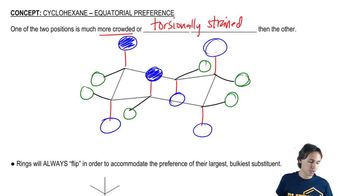
In cyclohexane chair conformations, substituents can be axial (pointing up or down from the ring) or equatorial (extending outward from the ring plane). Equatorial positions are generally more stable due to less steric hindrance. Recognizing these positions is essential for determining the most stable configuration of substituents, especially in trans-1,2 arrangements where both groups must be either axial or equatorial.
Recommended video:
Guided course
04:02
Equatorial Preference