
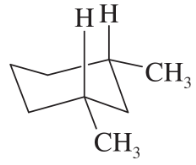
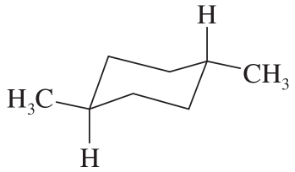
Use your results from Problem 3-27 to complete the following table. Each entry shows the positions of two groups arranged as shown. For example, two groups that are trans on adjacent carbons (trans-1,2) must be both equatorial (e,e) or both axial (a,a).
Ch.3 - Structure and Stereochemistry of Alkanes
Chapter 3, Problem 26e,f
Name the following compounds. Remember that two up bonds are cis; two down bonds are cis; one up bond and one down bond are trans.
(e) 
(f) 
Verified step by step guidance1
Step 1: Identify the longest carbon chain in the compound. This will be the parent chain and will determine the base name of the compound.
Step 2: Number the carbon atoms in the parent chain starting from the end nearest to the first point of difference, which could be a substituent or a double bond.
Step 3: Identify and name any substituents attached to the parent chain. Substituents are groups that branch off from the main chain, such as alkyl groups or halogens.
Step 4: Determine the stereochemistry of the compound. For cis-trans isomers, check the orientation of the substituents around the double bond. Two substituents on the same side are 'cis', while on opposite sides are 'trans'.
Step 5: Combine the information from the previous steps to write the full name of the compound, including the stereochemistry, substituents, and the parent chain.

Verified video answer for a similar problem:
This video solution was recommended by our tutors as helpful for the problem above.
Video duration:
5mWas this helpful?
Key Concepts
Here are the essential concepts you must grasp in order to answer the question correctly.
Cis-Trans Isomerism
Cis-trans isomerism is a type of stereoisomerism where the relative orientation of functional groups within a molecule differs. In cis isomers, similar groups are on the same side of a double bond or ring, while in trans isomers, they are on opposite sides. This concept is crucial for understanding the spatial arrangement and naming of compounds with double bonds or rings.
Recommended video:
Guided course
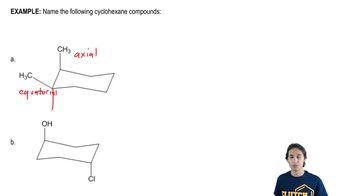
Is the following cyclohexane cis or trans?
Stereochemistry
Stereochemistry involves the study of the spatial arrangement of atoms in molecules and how this affects their chemical behavior. It is essential for naming compounds, as different spatial arrangements can lead to different isomers with distinct properties. Understanding stereochemistry helps in identifying whether a compound is cis or trans based on the orientation of its bonds.
Recommended video:
Polymer Stereochemistry Concept 1
IUPAC Nomenclature
IUPAC nomenclature is a standardized system for naming chemical compounds. It provides rules for naming organic molecules based on their structure, including the identification of functional groups, chain length, and stereochemistry. Mastery of IUPAC rules is necessary for accurately naming compounds, especially when considering isomerism and the orientation of bonds.
Recommended video:
Guided course
The different parts of an IUPAC name
Related Practice
Textbook Question
1
views
Textbook Question
a. Draw both chair conformations of cis-1,4-dimethylcyclohexane, and determine which conformer is more stable.
b. Repeat for the trans isomer.
c. Predict which isomer (cis or trans) is more stable.
1
views
Textbook Question
Draw the most stable conformation of
c. cis-1-tert-butyl-4-isopropylcyclohexane.
2
views
Textbook Question
Draw the most stable conformation of
b. 3-isopropyl-1,1-dimethylcyclohexane.
2
views
Textbook Question
Draw the two chair conformations of each of the following substituted cyclohexanes. In each case, label the more stable conformation.
a. cis-1-ethyl-2-methylcyclohexane
b. trans-1,2-diethylcyclohexane
1
views
Textbook Question
Name the following compounds. Remember that two up bonds are cis; two down bonds are cis; one up bond and one down bond are trans.
(c)
(d)
3
views
