
Ch.3 - Structure and Stereochemistry of Alkanes
Wade - Organic Chemistry 9th Edition
Wade9th EditionOrganic ChemistryISBN: 9780135213728Not the one you use?Change textbook
Chapter 3, Problem 27

a. Draw both chair conformations of cis-1,4-dimethylcyclohexane, and determine which conformer is more stable.
b. Repeat for the trans isomer.
c. Predict which isomer (cis or trans) is more stable.

Verified step by step guidance
1
Step 1: Understand the structure of cyclohexane and its chair conformation. Cyclohexane can adopt a chair conformation, which is the most stable due to minimized steric strain. In this conformation, substituents can be either axial (pointing up or down) or equatorial (pointing outwards).
Step 2: Draw the chair conformation for cis-1,4-dimethylcyclohexane. In the cis isomer, both methyl groups are on the same side of the cyclohexane ring. Place one methyl group in an axial position and the other in an equatorial position on the same side of the ring. Then, draw the flipped chair conformation, where the axial becomes equatorial and vice versa.
Step 3: Determine the stability of the cis conformations. Generally, equatorial positions are more stable due to less steric hindrance. Compare the two cis conformations and identify which has more substituents in equatorial positions.
Step 4: Draw the chair conformation for trans-1,4-dimethylcyclohexane. In the trans isomer, the methyl groups are on opposite sides of the cyclohexane ring. Place one methyl group in an axial position and the other in an equatorial position on opposite sides of the ring. Then, draw the flipped chair conformation.
Step 5: Compare the stability of the cis and trans isomers. Consider the number of equatorial substituents in each isomer's most stable conformation. Generally, the isomer with more equatorial substituents will be more stable due to reduced steric strain.

Verified video answer for a similar problem:

This video solution was recommended by our tutors as helpful for the problem above.
Video duration:
9m
Was this helpful?

Key Concepts

Here are the essential concepts you must grasp in order to answer the question correctly.

Chair Conformation

Chair conformation is a three-dimensional shape that cyclohexane adopts to minimize steric strain and torsional strain. In this conformation, carbon atoms are arranged in a zigzag pattern, resembling a chair, which allows for staggered interactions between hydrogen atoms, reducing repulsion and increasing stability.
Recommended video:
Guided course
03:29
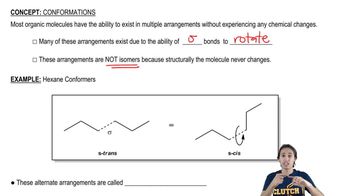
Understanding what a conformer is.

Axial and Equatorial Positions

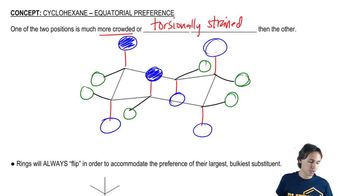
In cyclohexane chair conformations, substituents can occupy axial or equatorial positions. Axial positions are perpendicular to the ring plane, while equatorial positions are parallel. Equatorial positions are generally more stable due to less steric hindrance, as axial substituents can cause 1,3-diaxial interactions, leading to increased steric strain.
Recommended video:
Guided course
04:02
Equatorial Preference

Cis-Trans Isomerism

Cis-trans isomerism refers to the arrangement of substituents around a cyclohexane ring. In cis isomers, substituents are on the same side, while in trans isomers, they are on opposite sides. This spatial arrangement affects the molecule's stability, as trans isomers often have less steric hindrance compared to cis isomers, potentially making them more stable.
Recommended video:
Guided course
00:44
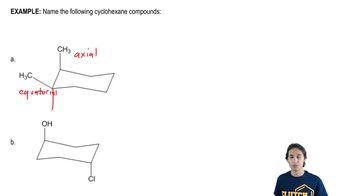
Is the following cyclohexane cis or trans?