Ch. 21 - Carboxylic Acid Derivatives
Wade - Organic Chemistry 9th Edition
Wade9th EditionOrganic ChemistryISBN: 9780135213728Not the one you use?Change textbook
Chapter 21, Problem 43g,h

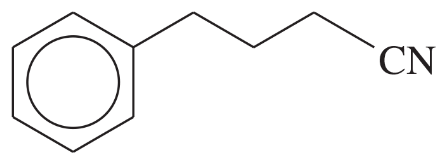
Give appropriate names for the following compounds:
(g)
(h)

Verified step by step guidance
1
Step 1: Analyze the first compound (g). The structure contains a benzene ring attached to a nitrile group (-C≡N). The nitrile group is directly bonded to the benzene ring, making it a derivative of benzonitrile.
Step 2: Name the first compound (g) according to IUPAC nomenclature. Since the nitrile group is the principal functional group and directly attached to the benzene ring, the compound is named 'benzonitrile'.
Step 3: Analyze the second compound (h). The structure contains a benzene ring attached to a propyl chain, which is further attached to a nitrile group (-C≡N). The nitrile group is at the terminal end of the propyl chain.
Step 4: Name the second compound (h) according to IUPAC nomenclature. The benzene ring is considered a substituent, and the longest chain containing the nitrile group is a three-carbon chain (propane). The nitrile group is the principal functional group, and the benzene ring is named as a substituent (phenyl group). The compound is named '3-phenylpropanenitrile'.
Step 5: Confirm the names by ensuring that the principal functional group (nitrile) is correctly prioritized and the substituents are named according to their positions and structure.

Verified video answer for a similar problem:

This video solution was recommended by our tutors as helpful for the problem above.
Video duration:
3m
Was this helpful?

Key Concepts

Here are the essential concepts you must grasp in order to answer the question correctly.

Nitriles

Nitriles are organic compounds that contain a cyano group (C≡N) attached to a carbon atom. They are characterized by their triple bond between carbon and nitrogen, which gives them unique chemical properties. Nitriles can be derived from carboxylic acids by replacing the hydroxyl group with a cyano group, and they are often used in organic synthesis and as intermediates in the production of various chemicals.
Recommended video:
Guided course
01:01
Nitrile Nomenclature

Aromatic Compounds

Aromatic compounds are a class of cyclic compounds that follow Huckel's rule, which states that they must have a planar structure with a specific number of π electrons (4n + 2, where n is a non-negative integer). The most common example is benzene, which consists of six carbon atoms arranged in a ring with alternating double bonds. Aromatic compounds exhibit unique stability and reactivity due to their delocalized π electrons, making them important in organic chemistry.
Recommended video:
Guided course
08:19
Intro to Aromaticity

IUPAC Nomenclature

IUPAC nomenclature is a systematic method for naming chemical compounds based on their structure and functional groups. It provides a standardized way to communicate the identity of a compound, ensuring clarity and consistency in chemical literature. For compounds containing functional groups like nitriles, the IUPAC name typically includes the longest carbon chain containing the cyano group, with appropriate prefixes and suffixes to indicate the presence of other substituents or functional groups.
Recommended video:
Guided course
03:43
The different parts of an IUPAC name