Ch. 21 - Carboxylic Acid Derivatives
Wade - Organic Chemistry 9th Edition
Wade9th EditionOrganic ChemistryISBN: 9780135213728Not the one you use?Change textbook
Chapter 21, Problem 43c,d

Give appropriate names for the following compounds:
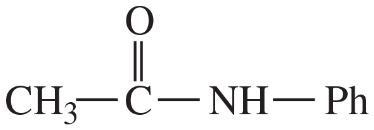
(c)
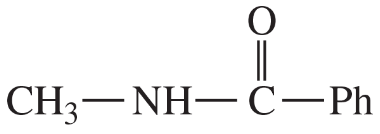
(d)

Verified step by step guidance
1
Step 1: Analyze the structure of compound (c). The compound contains a methyl group (CH₃) attached to a carbonyl group (C=O), which is further connected to an amine group (NH) and a phenyl group (Ph). This indicates the compound is an amide.
Step 2: Name the alkyl group attached to the nitrogen atom in compound (c). The phenyl group (Ph) is directly bonded to the nitrogen atom, so it is named as 'N-phenyl'.
Step 3: Name the acyl group in compound (c). The acyl group consists of a methyl group (CH₃) attached to the carbonyl group (C=O). This is named as 'acetamide'.
Step 4: Combine the names for compound (c). The full name is formed by combining the substituent on the nitrogen ('N-phenyl') with the acyl group ('acetamide').
Step 5: Analyze compound (d). The structure contains a methyl group (CH₃) attached to an amine group (NH), which is further connected to a carbonyl group (C=O) and a phenyl group (Ph). This indicates the compound is also an amide, but the arrangement differs from compound (c).

Verified video answer for a similar problem:

This video solution was recommended by our tutors as helpful for the problem above.
Video duration:
4m
Was this helpful?

Key Concepts

Here are the essential concepts you must grasp in order to answer the question correctly.

Amides

Amides are organic compounds characterized by the presence of a carbonyl group (C=O) directly attached to a nitrogen atom (N). They can be derived from carboxylic acids and are commonly found in proteins and synthetic materials. The naming of amides typically involves identifying the carbon chain and the substituents attached to the nitrogen.
Recommended video:
Guided course
01:33
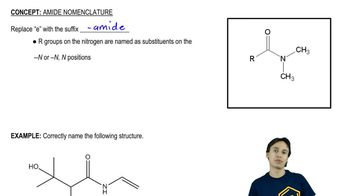
Amide Nomenclature

IUPAC Nomenclature

IUPAC nomenclature is a systematic method for naming organic chemical compounds. It provides rules for naming based on the structure of the molecule, including the longest carbon chain, functional groups, and substituents. Understanding these rules is essential for accurately naming compounds like amides, which may have complex structures.
Recommended video:
Guided course
03:43
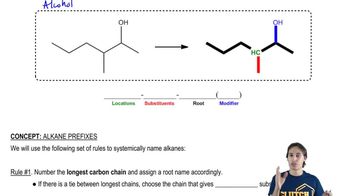
The different parts of an IUPAC name

Functional Groups

Functional groups are specific groups of atoms within molecules that are responsible for the characteristic chemical reactions of those molecules. In the case of amides, the functional group is the -C(=O)NH- moiety. Recognizing functional groups is crucial for predicting the behavior and reactivity of organic compounds.
Recommended video:
Guided course
02:36
Identifying Functional Groups