Ch. 21 - Carboxylic Acid Derivatives
Wade - Organic Chemistry 9th Edition
Wade9th EditionOrganic ChemistryISBN: 9780135213728Not the one you use?Change textbook
Chapter 21, Problem 42n,o

Draw structures to correspond with the following common and systematic names:
(n) trichloroacetic anhydride
(o) ethyl N-methyl carbamate

Verified step by step guidance
1
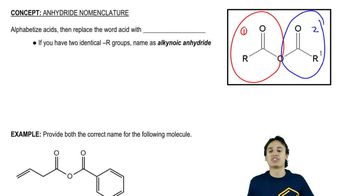
Step 1: Understand the structure of trichloroacetic anhydride. An anhydride is formed by the condensation of two carboxylic acids. Trichloroacetic acid has the formula Cl₃C-COOH. To form the anhydride, two molecules of trichloroacetic acid lose a water molecule, resulting in the structure Cl₃C-CO-O-CO-CCl₃.
Step 2: Draw the structure of trichloroacetic anhydride. Start by drawing two trichloroacetic acid molecules (Cl₃C-COOH). Then, connect the carbonyl groups (C=O) of each molecule via an oxygen atom (O) to form the anhydride bond.
Step 3: Understand the structure of ethyl N-methyl carbamate. A carbamate is a functional group with the general structure R-O-C(=O)-NR₂. In this case, the R group attached to the oxygen is an ethyl group (CH₃CH₂-), and one of the substituents on the nitrogen is a methyl group (CH₃).
Step 4: Draw the structure of ethyl N-methyl carbamate. Start with the carbamate backbone (R-O-C(=O)-NR₂). Replace the R group attached to the oxygen with an ethyl group (CH₃CH₂-), and replace one of the R groups on the nitrogen with a methyl group (CH₃). The final structure is CH₃CH₂-O-C(=O)-NHCH₃.
Step 5: Verify the structures. Ensure that all atoms have the correct number of bonds and that the functional groups match the names provided. For trichloroacetic anhydride, confirm the presence of two trichloromethyl groups (Cl₃C-) and the anhydride bond. For ethyl N-methyl carbamate, confirm the ethyl group, carbamate group, and N-methyl substitution.

Verified video answer for a similar problem:

This video solution was recommended by our tutors as helpful for the problem above.
Video duration:
1m
Was this helpful?

Key Concepts

Here are the essential concepts you must grasp in order to answer the question correctly.

Anhydrides

Anhydrides are compounds formed from the removal of water from an acid. In organic chemistry, they often result from the condensation of two carboxylic acids or a carboxylic acid and an alcohol. Trichloroacetic anhydride, for example, is derived from trichloroacetic acid and is used in various chemical reactions, including acylation.
Recommended video:
Guided course
03:35
Anhydride Nomenclature

Carbamates

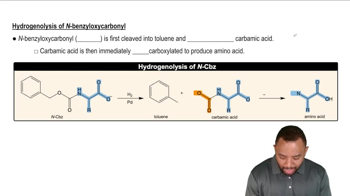
Carbamates are esters of carbamic acid, characterized by the presence of the -NH(C=O)O- functional group. They are commonly used in pharmaceuticals and pesticides. Ethyl N-methyl carbamate, specifically, is an example where an ethyl group is attached to the oxygen of the carbamate, influencing its chemical properties and reactivity.
Recommended video:
1:38
Reactions of Amino Acids: Hydrogenolysis Concept 2

Nomenclature in Organic Chemistry

Nomenclature in organic chemistry refers to the systematic method of naming chemical compounds based on their structure and functional groups. The IUPAC (International Union of Pure and Applied Chemistry) system provides rules for naming compounds, ensuring that each name conveys specific information about the molecular structure, such as the presence of functional groups and the arrangement of atoms.
Recommended video:
Guided course
00:56
What is an organic molecule?