Ch. 21 - Carboxylic Acid Derivatives
Wade - Organic Chemistry 9th Edition
Wade9th EditionOrganic ChemistryISBN: 9780135213728Not the one you use?Change textbook
Chapter 21, Problem 43k,l

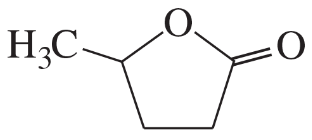
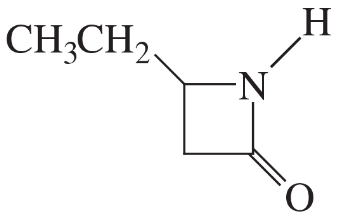
Give appropriate names for the following compounds:
(k)
(l)

Verified step by step guidance
1
Step 1: Analyze the structure of compound (k). It is a cyclic compound with a five-membered ring containing one oxygen atom and one ketone group. Additionally, there is a methyl group attached to the ring.
Step 2: Identify the functional groups in compound (k). The ketone group (-C=O) is the primary functional group, and the oxygen atom in the ring indicates that it is an ester or lactone.
Step 3: Determine the base name for compound (k). Since it is a five-membered ring with one oxygen atom, the base name is 'furanone.' The methyl group at position 3 modifies the name.
Step 4: Analyze the structure of compound (l). It is a cyclic compound with a four-membered ring containing one nitrogen atom and one ketone group. Additionally, there is an ethyl group attached to the nitrogen atom.
Step 5: Determine the base name for compound (l). Since it is a four-membered ring with one nitrogen atom, the base name is 'azetidinone.' The ethyl group attached to the nitrogen modifies the name.

Verified video answer for a similar problem:

This video solution was recommended by our tutors as helpful for the problem above.
Video duration:
4m
Was this helpful?

Key Concepts

Here are the essential concepts you must grasp in order to answer the question correctly.

Nomenclature of Organic Compounds

Nomenclature in organic chemistry refers to the systematic naming of chemical compounds based on their structure and functional groups. The International Union of Pure and Applied Chemistry (IUPAC) provides rules for naming compounds, which include identifying the longest carbon chain, determining the functional groups present, and assigning locants to indicate the position of substituents.
Recommended video:
Guided course
01:40
Defining meso compounds.

Functional Groups

Functional groups are specific groups of atoms within molecules that are responsible for the characteristic chemical reactions of those molecules. In the context of the question, amides are a key functional group characterized by a carbonyl group (C=O) directly attached to a nitrogen atom (N). Understanding functional groups is essential for naming compounds and predicting their reactivity.
Recommended video:
Guided course
02:36
Identifying Functional Groups

Ring Structures in Organic Chemistry

Ring structures, or cyclic compounds, are molecules that contain a closed loop of atoms. In organic chemistry, these can include various types of rings, such as five-membered or six-membered rings. The presence of a ring can influence the compound's stability, reactivity, and nomenclature, making it crucial to recognize and correctly name these structures when analyzing organic compounds.
Recommended video:
Guided course
03:49
How to use Organic Chemistry to make Lewis Structures easier.