How many stereoisomers are possible for c. a ketotriose?
Ch. 20 - Carboxylic Acids
Chapter 20, Problem 11a,b
Show how you would synthesize the following carboxylic acids, using the indicated starting materials.
(a) oct-4-yne → butanoic acid
(b) trans-cyclodecene → decanedioic acid
Verified step by step guidance1
For part (a), oct-4-yne to butanoic acid: Begin by recognizing that oct-4-yne is an alkyne, and oxidative cleavage of alkynes can yield carboxylic acids. Use a strong oxidizing agent such as potassium permanganate (KMnO₄) or ozone (O₃) followed by hydrolysis to cleave the triple bond into two carboxylic acids. The cleavage will produce two molecules of butanoic acid since the alkyne is symmetrically substituted.
For part (a), ensure the reaction conditions are acidic or neutral during the oxidative cleavage to facilitate the formation of carboxylic acids from the intermediate products.
For part (b), trans-cyclodecene to decanedioic acid: Recognize that trans-cyclodecene is a cyclic alkene. Oxidative cleavage of alkenes can yield diacids if the double bond is part of a ring. Use ozone (O₃) followed by hydrogen peroxide (H₂O₂) or KMnO₄ under acidic conditions to cleave the double bond and open the ring, forming decanedioic acid.
For part (b), ensure the reaction conditions are carefully controlled to avoid over-oxidation or side reactions. The oxidative cleavage will break the double bond and introduce carboxylic acid groups at both ends of the resulting open-chain molecule.
Verify the products for both parts by analyzing the structures and ensuring the correct number of carbon atoms and functional groups are present in the final carboxylic acids.

Verified video answer for a similar problem:
This video solution was recommended by our tutors as helpful for the problem above.
Video duration:
5mWas this helpful?
Key Concepts
Here are the essential concepts you must grasp in order to answer the question correctly.
Carboxylic Acid Synthesis
Carboxylic acids can be synthesized through various methods, including oxidation of alcohols, hydrolysis of nitriles, and carbon chain elongation. Understanding the functional groups and reactivity of starting materials is crucial for determining the appropriate synthetic route. In this case, the transformation of alkynes and alkenes into carboxylic acids involves specific reactions that introduce the carboxyl group (-COOH) into the molecule.
Recommended video:
Guided course
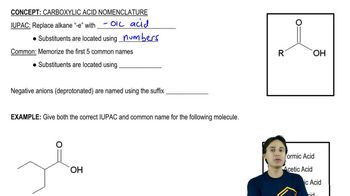
Carboxylic Acids Nomenclature
Alkyne Reactivity
Alkynes, characterized by a carbon-carbon triple bond, can undergo various reactions, including hydrolysis and oxidation. For the synthesis of butanoic acid from oct-4-yne, a key step involves the hydration of the alkyne to form a ketone, which can then be further oxidized to yield the desired carboxylic acid. Understanding the mechanisms of these reactions is essential for predicting the products formed during synthesis.
Recommended video:
Guided course
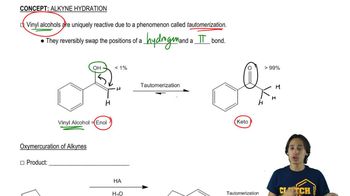
Alkyne Hydration
Cycloalkene Reactions
Cycloalkenes, such as trans-cyclodecene, can participate in reactions that lead to the formation of carboxylic acids. In this case, the ring-opening reaction followed by oxidation can be employed to synthesize decanedioic acid. Familiarity with the behavior of cyclic compounds and their reactivity patterns is important for successfully navigating the synthesis of complex molecules from simpler starting materials.
Recommended video:
Guided course
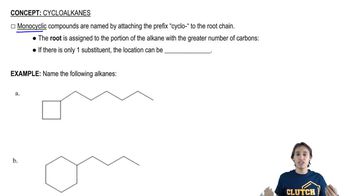
How to find the root name for cycloalkanes
Related Practice
Textbook Question
2
views
Textbook Question
Write the mechanism for the base-catalyzed conversion of D-fructose to D-glucose and D-mannose.
1
views
Textbook Question
Show how you would synthesize the following carboxylic acids, using the indicated starting materials.
(e) p-xylene → terephthalic acid
1
views
Textbook Question
Show how you would synthesize the following carboxylic acids, using the indicated starting materials.
(f) allyl iodide → but-3-enoic acid
4
views
Textbook Question
The IR spectrum of trans-oct-2-enoic acid is shown. Point out the spectral characteristics that allow you to tell that this is a carboxylic acid, and show which features lead you to conclude that the acid is unsaturated and conjugated.
<IMAGE>
2
views
Textbook Question
Show how you would synthesize the following carboxylic acids, using the indicated starting materials.
(d) butan-2-ol → 2-methylbutanoic acid